
A new study by the Taub Center for Social Policy Studies in Israel points to a growing phenomenon of “boundary-crossing teachers,” reshaping the composition of Israeli teaching staff. Nachum Blass, Principal Researcher and Chair, Taub Center Education Policy Program, and Dr. David Maagan, Director, Higher Education and Teaching Staff Sector, Israel Central Bureau of Statistics, examined the data from 2010 to 2025 on the integration of teachers working in schools belonging to a different sector or supervisory stream than the one in which they were trained. The researchers focused on two aspects of this phenomenon: veteran and new Arab teachers, and new teachers from all sectors. The data show that the share of Arab teachers (veteran and new) teaching in the Hebrew State school system quadrupled during this period, rising from less than 1% in 2010 to 4% in 2025. In fact, one in four schools in the Hebrew State system now employs at least two Arab teachers. As for new teachers, the study finds that in the State-religious education system, the share of those trained in Haredi institutions rose from 19% in 2010 to 31% in 2025. The findings also challenge concerns that integrating teachers trained in a different sector into school staff undermines educational quality.
Recruitment difficulties as a driver of change
Israel’s education system is divided into four separate subsystems: Hebrew State education, State-religious education, Haredi education, and Arab State education. School principals naturally prefer to hire teachers trained in institutions whose values align with those of the school. However, recruitment difficulties in the Hebrew State and State-religious systems have increasingly compelled principals to cross sectoral boundaries and recruit teachers from different backgrounds and trained in different sectors. Thus, many Hebrew State schools now employ Arab, religious, and Haredi teachers, while many State-religious schools employ teachers trained in Haredi training institutions. It should be noted that this phenomenon is limited to the Hebrew State and State-religious education systems.
Hebrew State education is the most diverse, with a steady rise in Arab teachers
The data indicate that Hebrew State education has become a major destination for teachers trained in other sectors. A reasonable estimate is that between 30% and 40% of the new teachers hired in Hebrew State schools over the past five years come from a religious sector or from the Arab sector. The share of teachers in Hebrew State schools who were trained in State-religious institutions rose from 8.6% in 2010 to 18.2% in 2025. The share of Arab teachers increased from 2.8% to 7%, and the share of teachers trained in Haredi institutions rose from 1.2% to 5.6%. This trend reflects a shift away from reliance on teachers trained in Hebrew State training institutions toward broader recruitment from other sectors.
Today, in one out of every four Hebrew State schools (26%), at least two Arab teachers are on staff. The phenomenon is particularly evident in mixed cities or those located near Arab localities. In Haifa, for example, the share of schools employing two or more Arab teachers jumped from 6% in 2010 to 83% in 2025, while in Kfar Saba it rose from 8% to 71%. Over the same period, the share of schools with a completely homogeneous teaching staff declined dramatically: whereas in 2010, 89% of schools had no Arab teachers on staff, by 2025 this figure had fallen to 59%.
Despite these impressive integration rates, Arab teachers often face a complex reality in Jewish schools. In surveys, many reported that they sometimes feel compelled to downplay their national or political identity in order to avoid confrontation, often choosing silence as a strategy for social survival. During periods of heightened security tensions, these difficulties intensify, and teachers report feeling the need to demonstrate their loyalty and professionalism in an environment that can at times feel distrustful.
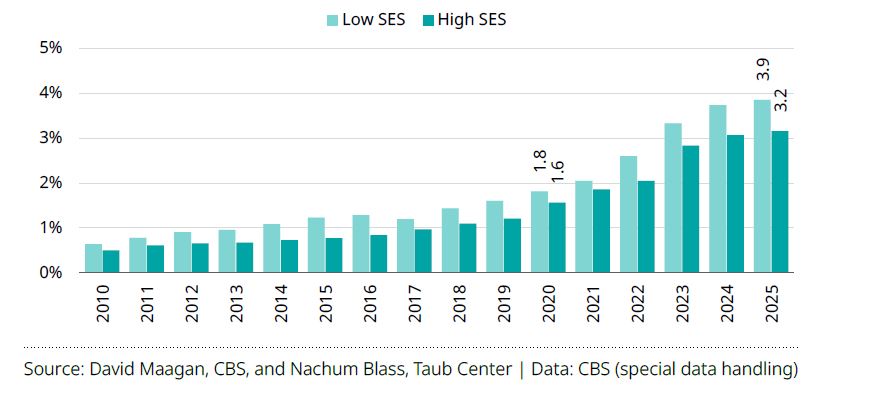
Another finding of the study relates to the school’s socioeconomic status (SES). Overall, an upward trend was observed in the integration of Arab teachers within the Hebrew State education system in schools serving both disadvantaged and more affluent student populations. Nevertheless, the scale of recruitment for Arab teachers is higher in schools with students from low socioeconomic backgrounds – 3.9%, compared to 3.2% in schools with students from high socioeconomic backgrounds. This may be due to the fact that in schools serving high SES populations parental resistance to employing Arab teachers is more effective. Additionally, these schools may be more attractive to teachers from the Jewish sector. Conversely, in schools serving students from lower socioeconomic backgrounds, the demand for teachers outweighs social barriers, leading to a broader adoption of cross-sectoral teachers.
Share of Arab teachers in State Hebrew education, by students SES
State-religious education: Growing reliance on Haredi teachers
Alongside the changes in Hebrew State education, teachers trained in the Haredi sector have become an important source of manpower for the State-religious system. The share of new teachers with Haredi training in State-religious education rose sharply from 19% in 2010 to 31% in 2025, and in primary schools, they now account for nearly 40% of new teachers. In middle schools and high schools, Haredi-trained teachers make up more than 22% of new English (as a second language) teachers, about 19% of new Hebrew (language arts) teachers, and roughly 18% of new mathematics teachers. The study emphasizes that despite differences in their training background, their integration does not affect students’ Bagrut (matriculation) outcomes, suggesting that they provide a professional and stable solution to staffing shortages in the State-religious education system.
Subject training and academic outcomes: Addressing shortages while maintaining education achievement levels
The presence of boundary-crossing teachers is evident across many taught subject areas. The number of boundary-crossing mathematics teachers increased twenty-three-fold, from about 20 teachers in 2012 to roughly 470 in 2025. In special education, the number rose eight-fold, from about 110 teachers to around 800.
At the same time, the researchers analyzed the educational background of new Arab teachers compared with that of their Jewish colleagues. The findings show that the average Bagrut score of Arab teachers in Hebrew State schools is higher than — or at least comparable to — that of Jewish teachers. Moreover, an examination of the relationship between the share of new boundary-crossing teachers in a school and student Bagrut achievement outcomes reveals a positive and statistically significant, though weak, association. By contrast, there is a negative, though weak, association between the share of Haredi teachers and Bagrut outcomes. In the State-religious system, the integration of Haredi teachers shows no effect on students’ Bagrut achievements, while a negative relationship is observed between the share of teachers trained in Hebrew State training institutions (most of whom are likely religious) and Bagrut outcomes.
The phenomenon of boundary-crossing teachers is no longer marginal; it has become a structural process that is increasingly important for the stability of the education system. It is likely to intensify further in light of demographic trends and disparities in the geographic distribution and placement of teachers. The study’s findings show that boundary-crossing teachers provide a professional and effective response to staffing shortages without harming student achievement. Beyond this, they may also serve as a cultural bridge between the different communities that make up Israeli society.
Nachum Blass, Chair of the Taub Center Education Policy Program: “In recent years, gaps in the geographic distribution and placement of teachers have led to a growing number of teachers working in an education sector different from the one in which they were trained. In practice, this now applies to at least 10% of teachers in the system, primarily in Hebrew State education. But beyond addressing teacher placement shortages, the emerging reality is strengthening the diversity of school teaching staff. It is important to recognize that this represents a rare educational opportunity to bring different worlds closer together. The integration of teachers from diverse cultural backgrounds can give both students and teaching staff the chance to encounter other groups in society and become familiar with different cultures. When this exposure occurs in both directions, it has the potential to promote multiculturalism and foster tolerance and coexistence within the education system and Israeli society as a whole.”
The Taub Center for Social Policy Studies in Israel is an independent, non-partisan socioeconomic research institute. The Center provides decision makers and the public with research and findings on some of the most critical issues facing Israel in the areas of education, health, welfare, labor markets and economic policy in order to impact the decision-making process in Israel and to advance the well-being of all Israelis.
For further details or to arrange an interview, please contact Hadar Horen, the Center Spokesperson: 050-6207943.