
In Israel, approximately 700,000 people are living with diabetes. Diabetes rates vary between localities and even between neighborhoods within the same city. These differences raise a question about the relationship between where people live and their health. A new study by the Taub Center for Social Policy Studies in Israel, conducted by Dr. Maya Sadeh, Yael Yavin, and Prof. Alex Weinreb, examined whether physical characteristics of residential areas, including the extent of vegetation and built-up areas, are associated with differences in diabetes prevalence among local residents. The study examined these associations above and beyond differences in age, population group, and socioeconomic status across areas in Israel. To this end, the researchers analyzed data on members of Clalit Health Services residing in 2,835 statistical areas throughout the country.
Diabetes is a chronic disease. Its most common form is type 2 diabetes, which accounts for approximately 90% of all cases. Dietary habits and physical activity influence the prevalence of the disease. These behaviors are also associated with socioeconomic status, and consequently, the likelihood of developing diabetes varies between countries, cities, and localities. In Israel, differences in diabetes rates can be observed both between localities and between areas within the same locality.
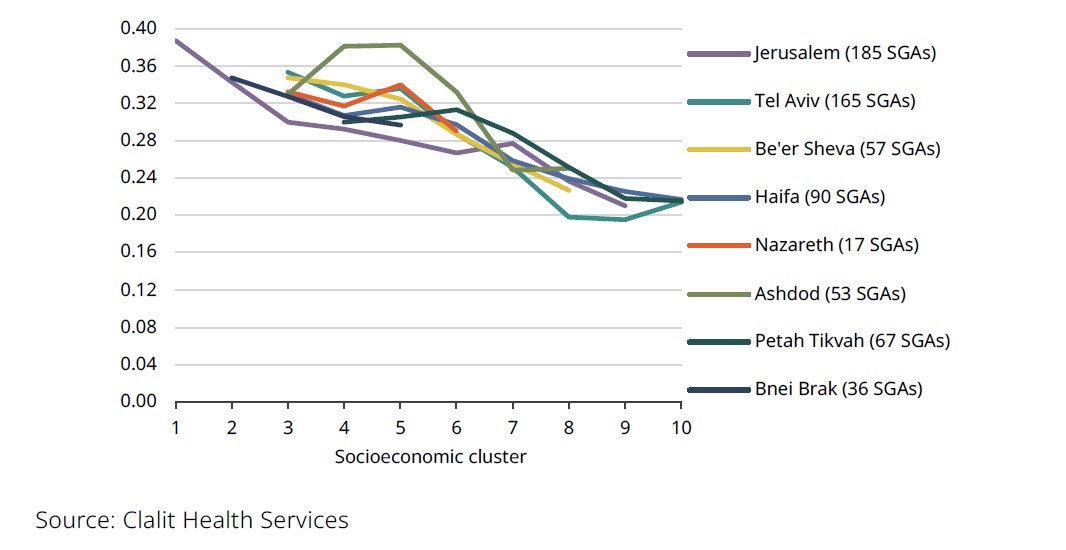
Average diabetes prevalence among Clalit Health Services members, by socioeconomic cluster of the statistical area, 2023
Urban quality of life in Israel’s planning policy
In recent decades, Israel has adopted a planning approach that focuses primarily on how the physical environment is designed (rather than simply on the allocation of land), recognizing the importance of the quality of urban space in shaping living conditions. This approach seeks to maintain urban continuity while preserving open spaces, given the latter’s significant contribution to residents’ health and health-related behaviors. This planning approach is particularly important in Israel, where more than 90% of the population lives in urban localities. The principles guiding the design of the living environment relate, among other things, to access to public transportation and reduced dependence on private vehicles, shaded public spaces, walking paths, and measures to address heat stress and climate risks.
Study findings indicate a direct association between the built environment and diabetes prevalence
Green spaces within built-up areas offer significant health benefits: they help reduce air and noise pollution and provide natural shade that encourages walking and physical activity in residential neighborhoods. Studies examining the association between exposure to green spaces and diabetes prevalence in various parts of the world indicate a reduction of approximately 11%–14% as the amount of green space in an area increases.
The findings of the current study indicate a direct association between diabetes prevalence and environments with extensive built-up surfaces, such as roads and buildings (known as impervious surfaces). These environments are characterized by air pollution, high noise levels, and higher ambient temperatures, partly due to the formation of urban heat islands.
The greater the extent of built-up surfaces, the higher the risk of diabetes: in areas at the 75th percentile of impervious surface coverage (where 87% of the land is built up), diabetes prevalence is approximately 19% higher than in areas at the 10th percentile (where 25% of the land is built up). After adjusting for green space, the difference is approximately 14%.
The study also found that part of the association between diabetes and socioeconomic status can be explained by the fact that urban areas inhabited by populations of lower socioeconomic status tend to have a higher proportion of impervious surfaces and fewer green spaces. This association between socioeconomic status and the proportion of green space explains approximately one-fifth of the particularly high diabetes prevalence in areas where the majority of residents belong to the Arab population.
High diabetes prevalence also has substantial economic implications: healthcare expenditure for a person with diabetes is nearly twice that for an insured individual without the disease. Even a modest reduction in diabetes prevalence or a delay of several years in the onset of the disease could generate considerable budgetary savings and reduce health inequalities.
In light of the study’s findings, the researchers proposed several policy measures that could help reduce diabetes prevalence in the population:
- Reducing environments dominated by asphalt and concrete – Urban renewal plans and the development of new neighborhoods should include targets for reducing the proportion of impervious surfaces. Measures could include converting open-air parking lots into green spaces with a variety of trees, promoting green roofs, and introducing drainage solutions that incorporate greenery and urban nature.
- Increasing green space within neighborhoods, rather than concentrating it solely in parks – Urban planning should focus on the even distribution of green spaces so that most residents have access to greenery within a short walking distance. This could be achieved through gardens near residential buildings and mature trees along routes that residents use in their daily lives. In this context, the policy of felling mature trees as part of urban renewal projects should be reconsidered. This recommendation is particularly important for disadvantaged populations in Israel, especially the Arab population, who face unequal access to green spaces.
- Incorporating monitoring and identification indicators to prioritize investment in high-risk areas – The Ministry of Health and other relevant government ministries should incorporate indicators to monitor and identify areas at high risk of diabetes and use them to prioritize infrastructure investment in disadvantaged neighborhoods. As a guideline for optimal urban planning, Israel could adopt the “3–30–300” rule used by the European Union and the World Health Organization: ensuring that every person can see at least three mature trees from their home, lives in a neighborhood with at least 30% tree canopy coverage and resides within 300 meters of a high-quality public green space.
- Establishing a health and environmental database – Such a database would provide a clear picture of the areas where interventions in the physical environment are needed to improve public health.
Dr. Maya Sadeh, Head of the Taub Center Initiative on Environment and Health Research and Policy: “We need to understand that green spaces are not merely a ‘pleasant aesthetic addition’ to residential neighborhoods. Our research findings point to a strong association between densely built-up environments and higher diabetes rates, and between green environments and lower diabetes rates in the greenest areas. Many urban residential areas in Israel lack sufficient green space, which helps reduce air and noise pollution and encourages walking and physical activity. This has implications for the health of residents for decades to come. Developing open and green spaces that are easily accessible to the public near their homes is an important and worthwhile investment, modest in cost relative to the benefits it can generate. It is the responsibility of policy makers to ensure that this happens.”
Prof. Alex Weinreb, Research Director and Head of the Taub Center Demography Area: “Urban planning plays a major role in shaping public health. The study points to a clear association between environmental characteristics and diabetes rates, even after accounting for factors such as socioeconomic status and environmental variables. Planning a new neighborhood or developing an urban renewal project requires careful consideration of the proportion of built-up land relative to green space and ensuring access to these green areas. At a time when nearly every city in Israel is advancing urban renewal projects and given the tendency to use every available plot of land for construction, it is more important than ever to preserve green spaces—and even to expand and enhance them—particularly in older neighborhoods, which are often home to more socioeconomically disadvantaged populations.”
The Taub Center for Social Policy Studies in Israel is an independent, non-partisan socioeconomic research institute. The Center provides decision makers and the public with research and findings on some of the most critical issues facing Israel in the areas of education, health, welfare, labor markets and economic policy in order to impact the decision-making process in Israel and to advance the well-being of all Israelis.
For details, or to arrange an interview, please contact Hadar Horen, Spokesperson: 050-6207943.