
Embargo until September 16, 2026 (Wednesday) at 6:00 am
A new study by the Taub Center addresses the perception that the consumer price index (CPI) does not reflect the actual cost of living as experienced by households in Israel. The study’s authors, Prof. Benjamin Bental and Dr. Labib Shami, show that excluding the “cost of money” (the interest households pay on mortgages and consumer credit) from the consumer price index leads to an underestimation of the economic burden on households, particularly during periods of sharp increases in interest rates.
Israel’s consumer price index, like that of most countries around the world, measures the prices of a basket of consumer goods and services. In the owner-occupied housing component, which accounts for about 18% of the index, measurement is based on the method of “imputed rent” — a hypothetical estimate of the rent homeowners would pay if they were renting their homes. While this method serves the standard definition of the index as a tool for measuring changes in the prices of a basket of consumer goods and services, it completely disregards housing prices themselves, as well as financing and interest costs, which have a direct and immediate effect on mortgage payments and household expenditures.
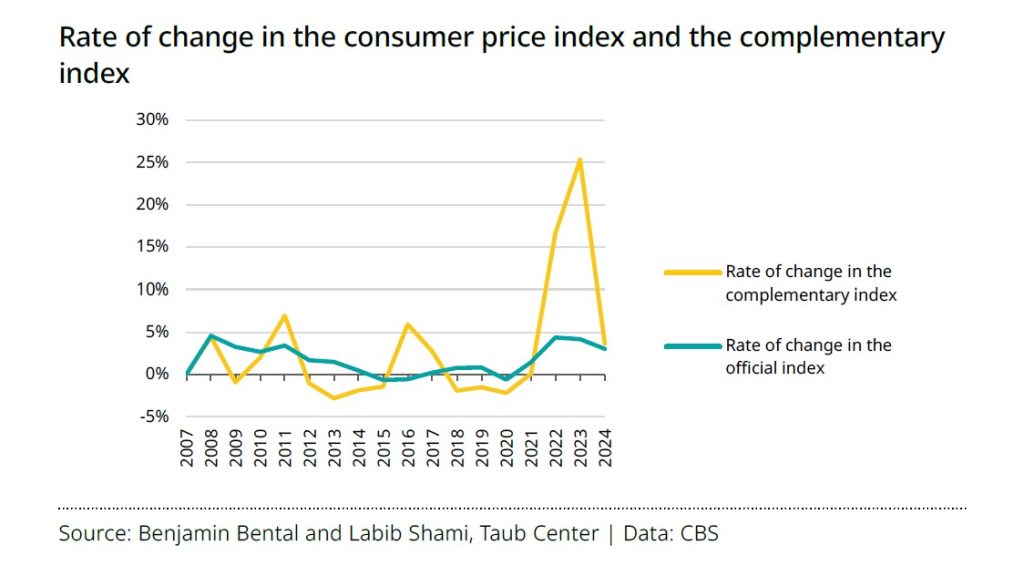
A calculation that includes housing financing costs shows that the surge in mortgage interest rates is a major driver of the actual increase in housing costs
To examine the extent of the gap, the researchers developed a complementary index in which the owner-occupied housing component is calculated not according to imputed rent but according to the actual cost of housing finance (housing prices multiplied by the weighted mortgage interest rate). The study’s findings show that while the official index displays relatively moderate fluctuations, the complementary index responds much more strongly to changes in financing conditions. A particularly large gap emerged in 2022–2023, when the Bank of Israel raised its policy interest rate. In those years, when the weighted average mortgage interest rate rose by dozens of percentage points (an increase of about 42% in 2022 and about 68% in 2023), the complementary index rose at a rate four times and six times as fast, respectively, as the official index. According to the researchers, the increase in housing costs in those years was driven primarily by the sharp rise in interest rates, but also by housing prices, which continued to increase.
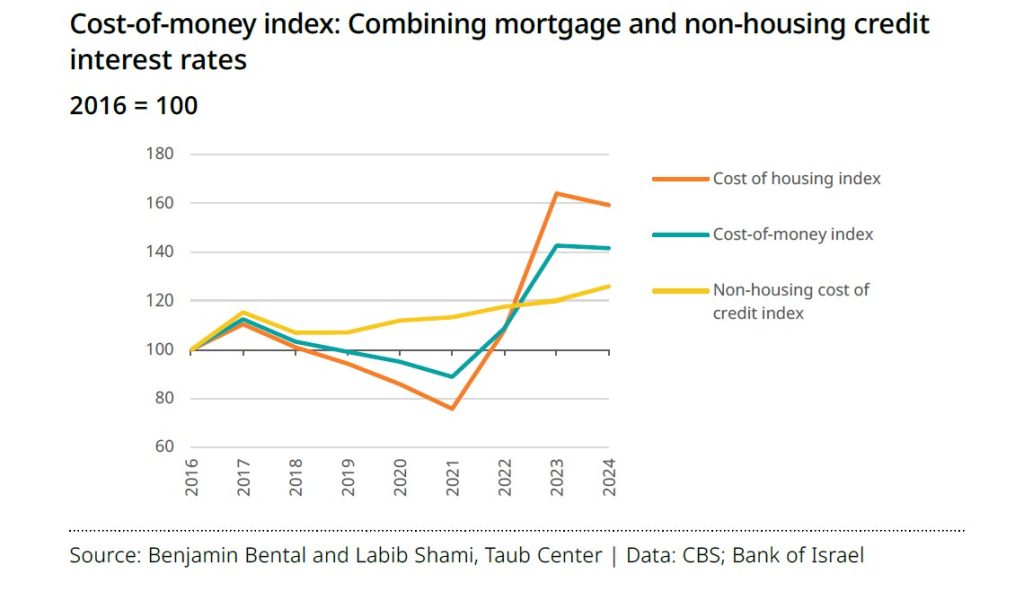
Since 2016 — a sharp rise in the cost of household debt
In addition to the complementary index, the researchers calculated another index for the years 2016–2024 — the “cost-of-money index” — designed to track changes in the financing conditions (interest rates) on household debt, including both mortgages and non-housing consumer credit. The index shows that while the official inflation rate remained relatively restrained, beginning in 2022 the cost of credit and household debt in Israel surged to record levels. This represents an actual erosion of households’ purchasing power that is not reflected in the official index as published by the Central Bureau of Statistics.
The researchers emphasize that the findings are not intended to challenge the validity of the consumer price index as a measure of inflation or to suggest that it should be replaced. However, when the index is used in practice as the primary benchmark for the cost of living and economic policy, the failure to account for the cost of money creates a serious gap in interpretation. They therefore recommend that, alongside the official index, supplementary indices that also take financing costs into account should be calculated and published, in order to provide decision makers and the public with a more realistic and comprehensive picture of the economic burden experienced by households in Israel.
Prof. Benjamin Bental, Principal Researcher and Chair of the Taub Center Economics Policy Program, says: “Following the Bank of Israel’s interest rate hikes, some members of the Knesset called on the Bank to moderate the pace of the increases, and there were even proposals within government circles to compensate households for them. Both proposals were sharply — and justifiably — criticized. Nevertheless, we believe there is value in proposing a supplementary index alongside the consumer price index that would quantify the public’s experience of the impact of interest rates and housing prices on the cost of living in Israel. Greater awareness of their effect on the cost of living as experienced by the public could have some influence, even if only marginal, on the Bank of Israel’s monetary policy.”
Dr. Labib Shami, a Taub Center Senior Researcher, adds: “The study shows that the question is not only how much the prices of goods and services have risen, but also how much it costs households to finance their standard of living. In years of sharp interest rate increases, the resulting rise in mortgage and credit costs has a substantial effect on families’ monthly cash flow, even when the consumer price index indicates relatively moderate inflation. It is therefore important that, alongside the official price index, the public and decision makers have access to supplementary indices that also reflect the cost of money. Such a broader picture can help policy makers better understand the economic pressures households face and improve the basis for decisions concerning economic policy.”
The Taub Center for Social Policy Studies in Israel is an independent, non-partisan socioeconomic research institute. The Center provides decision makers and the public with research and findings on some of the most critical issues facing Israel in the areas of education, health, welfare, labor markets and economic policy in order to impact the decision-making process in Israel and to advance the well-being of all Israelis.
For details, or to arrange an interview, please contact Chen Mashiach, Spokesperson: 054-7602151