
This research is currently available only in Hebrew.
A new Taub Center study examines the level of funding allocated by the Ministry of Education to middle schools across different sectors and supervisory streams, and asks whether any group receives preferential treatment. The findings show that despite a substantial narrowing of funding gaps between the Hebrew and Arab education systems in recent years, significant disparities between sectors persist. This study is the third in a series examining transparency and equity in Israel’s education system.
The study focuses on the years 2014–2023, a decade marked by major developments that affected the education system, including new wage agreements and the launch of the Gefen program (Administrative Pedagogical Flexibility), which channeled considerable resources to all schools.
A substantial narrowing of gaps between Hebrew and Arab education, and stability within the Hebrew education sector
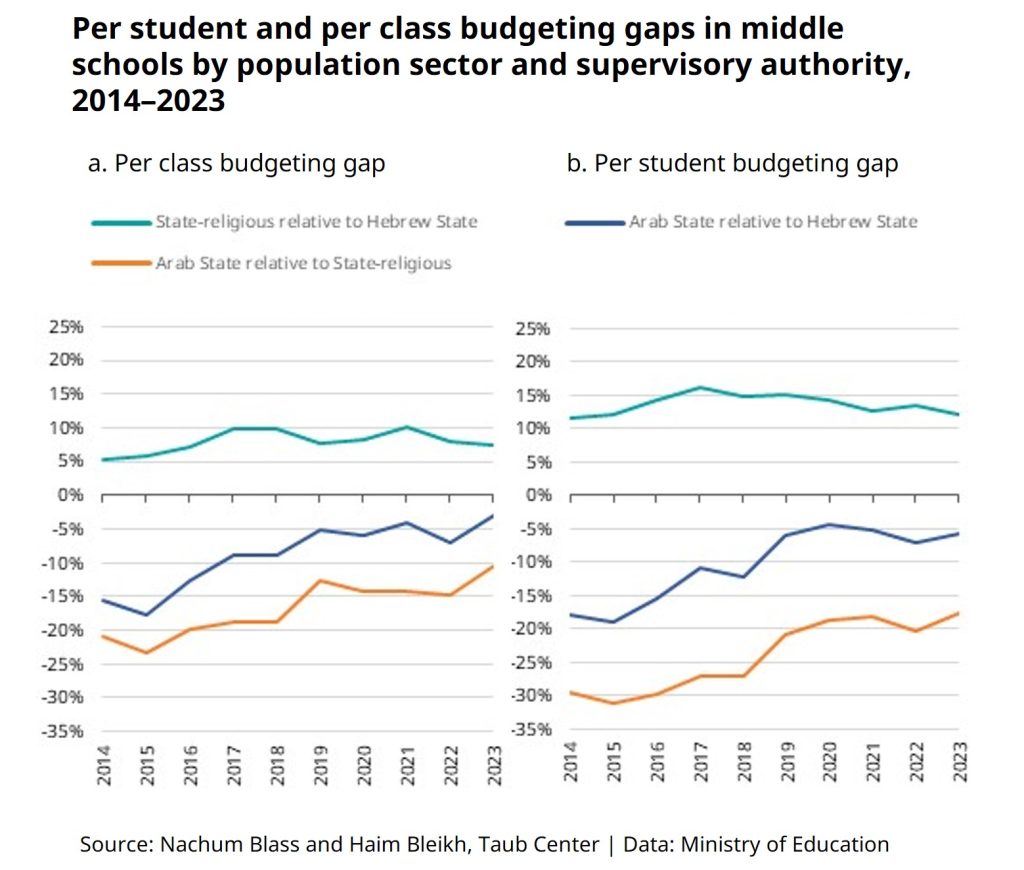
The study finds that after controlling for key explanatory variables — sector and supervisory stream, the Nurture Index, school size, and the share of special education classes (all of which underlie the Ministry of Education’s funding formulas) — the funding gaps between Hebrew State and State-religious schools remained nearly unchanged over the period examined. In per-class funding, the gap increased from 5% to 7% (peaking at about 10%), while per-student funding remained around 12% (peaking at about 16%). Between the Arab State sector and the Hebrew State sector, per-class funding gaps shrank from 15% to 3%, and per-student gaps fell from 18% to 6%. Compared with the State-religious sector, the Arab sector’s gaps narrowed from 21% to 11% in per-class funding and from 29% to 18% in per-student funding.
Questions about the principles guiding the funding formulas
The main reasons for changes in the funding gaps between Jewish and Arab schools are improvements in the socioeconomic profile of students in the State-religious sector, alongside a decline in school size and an increase in the share of special education classes in the Arab sector. With regard to the origins of the gaps across sectors and supervisory streams, the study finds that while the explanatory variables consistently account for a large share of the per-student funding gaps, their ability to explain per-class funding gaps is low — and has declined over time.
According to the researchers, this low explanatory power for per-class funding is troubling. If the gaps cannot be attributed to the official funding formulas, it may indicate that the allocations are influenced by external considerations that are not necessarily related to the characteristics of students or schools.
Nachum Blass, one of the study’s authors, notes: “The advantage enjoyed by the State-religious sector over the Arab and Hebrew State sectors stems mainly from the current funding formulas. If the Ministry of Education seeks to eliminate disparities between groups within the education system, it must revise these formulas and adhere firmly to any new ones that may be adopted.”
The Taub Center for Social Policy Studies in Israel is an independent, non-partisan socioeconomic research institute. The Center provides decision makers and the public with research and findings on some of the most critical issues facing Israel in the areas of education, health, welfare, labor markets and economic policy in order to impact the decision-making process in Israel and to advance the well-being of all Israelis.
For further details or to arrange an interview, please contact Chen Mashiach, the Center Spokesperson: 054-7602151.