
The Taub Center is publishing a short booklet presenting data showing that the extensive reserve duty performed since October 7 is expected to adversely affect the wages, employment, and higher education of reservists, and their families. The publication describes the characteristics of the reservist population and shows that reservists may find themselves at a relative disadvantage in the coming years. The study’s editors—Ori Oberman and Michael Debowy, who are themselves serving in the reserves, and Dr. Sarit Silverman, whose husband is a reservist—are publishing these data out of a sense of both personal and professional commitment, with the aim of raising awareness of the long-term consequences of prolonged reserve duty for reservists and their families.
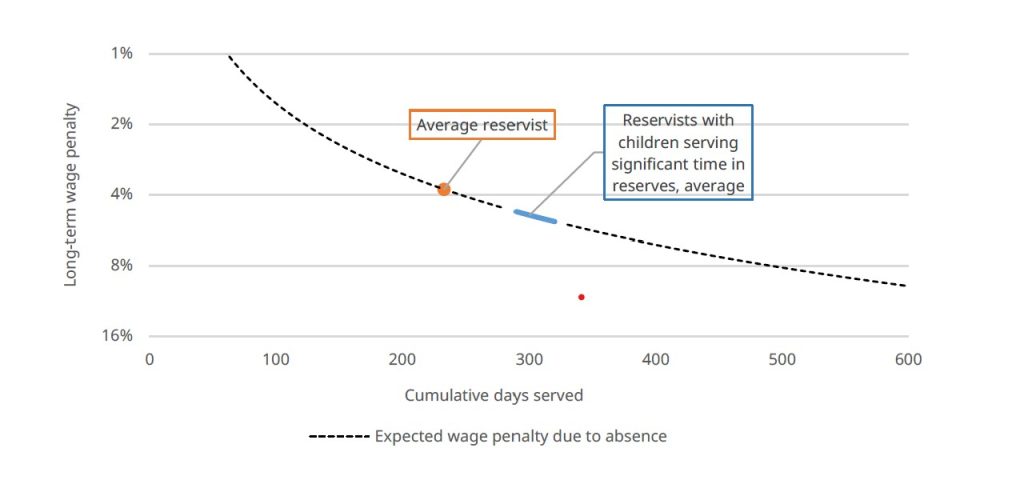
The data show that in 2024, the average financial compensation per reserve-duty day—total compensation divided by the total number of reserve-duty days—fell by about 30%. This may indicate either a change in the composition of the population called up for duty or an immediate adverse effect on reservists’ wages and employment. Over the longer term, prolonged reserve duty may lead to a lasting loss of earnings, with the impact increasing as the period of service grows longer. According to the most conservative estimate, the average reservist who served at least 233 days is expected to lose nearly 5% of their earnings. Among reservists who are fathers and served between 290 and 320 days—a group numbering more than 100,000—the expected loss is at least 6%. Under less conservative estimates, the decline in earnings could be as high as 20%.
In higher education, approximately 70,000 students served in the reserves during the 2024/25 academic year. That year, among Jews and Others—the population group that is bearing most of the burden—the share of undergraduate students fell to its lowest level since 2018/19. The decline was particularly pronounced at the peak ages for undergraduate study—ages 22–24 among women and 25–29 among men—and may reflect either students dropping out or a decline in enrolment among new students, despite the accommodations and support measures introduced.
The publication also reveals a substantial geographic disparity in the duration of reserve duty between the center of the country and the periphery. In the Central and Tel Aviv Districts, mobilization levels are flexible and vary in accordance with the intensity of the fighting and the needs of the military. By contrast, in Judea and Samaria and in the northern border subdistricts of the Golan, Tzfat, and Akko, mobilization levels are largely unaffected by national trends and remain stable over time. More specifically, residents of border localities in these districts and subdistricts face continuous strain and are called up repeatedly, regardless of broader trends in the fighting, apparently because of the demanding requirements of defending their communities and the intensive activity of local rapid-response teams.
Beyond the effects on reservists themselves, a parent’s reserve duty may also have emotional consequences for their children, as shown in previous Taub Center studies, some of which are also presented in the current booklet.
Finally, the researchers emphasize that the prolonged absence of such a large group from the labor market and the higher education system may also have national consequences, since it is expected to harm the level of human capital in the Israeli labor force over the long term.
Dr. Sarit Silverman, one of the study’s authors, says: “Since October 7, 2023, we have witnessed an unprecedented increase in the scale of reserve mobilization. Unfortunately, given the security reality that has emerged in recent years, this does not appear likely to change in the foreseeable future. Reservists are experiencing an escalation both in the number of days they are required to serve and in the intensity of that service. We hope that the data presented in this study will help raise awareness of the long-term sustainability of this model of reserve duty and of its many consequences for reservists and their families.”
Michael Debowy, another of the study’s authors, who has served more than 400 days in the reserves since October 7, adds: “The study reflects the reality of the disproportionate burden and diminishing opportunities facing young people in the labor market. It confirms the adverse effects of extensive reserve duty on higher education and family life and points to potentially substantial harm to employment and career development later in life. In my own experience as a reserve company commander, I see an entire generation of young reservists living from one round of duty to the next, trapped in a state of endless waiting that prevents them from beginning their ‘real lives.’”
The Taub Center for Social Policy Studies in Israel is an independent, non-partisan socioeconomic research institute. The Center provides decision makers and the public with research and findings on some of the most critical issues facing Israel in the areas of education, health, welfare, labor markets and economic policy in order to impact the decision-making process in Israel and to advance the well-being of all Israelis.
For further details or to arrange an interview, please contact Chen Mashiach, the Center Spokesperson: 054-7602151