


The Ministry of Education’s policy to manage food allergies in the school system rests on two elements that have no parallel in other countries: school-wide bans on declared allergens and the provision of medical assistants. Medical allergy associations recommend against school-wide bans, and since the medical assistant model xists only in Israel, there is no research base against which to evaluate it.
A new Taub Center study by Dr. Sarit Silverman and Prof. Nadav Davidovitch examines this policy and inequality in its implementation, using health declarations submitted by parents of students in grades 1–12 over four school years (2021/22–2024/25).
Bans and assistants instead of school nurses
The policy emerged as food allergy rates rose after school nurses were phased out starting in the 1990s. Since Israeli schools lack cafeterias and designated eating areas, students eat in their classrooms, making allergen exposure possible in the learning environment itself.
Unlike countries that have adopted targeted restrictions such as peanut-free zones, Israel imposes a school-wide ban on the declared allergen.
School-wide bans pose problems of their own. Medical allergy associations in Israel and abroad recommend against them, as there is no documented evidence that they reduce anaphylactic reactions. The bans are difficult to enforce, and they may create a false sense of security, restrict what other students can eat, and fuel conflict and bullying of children with allergies. They can also make it harder for students with allergies to develop self-management skills.
Rising declarations strain the education system
Between 2021/22 and 2024/25, the share of students whose parents declared an allergy or sensitivity (the sensitivity rate) more than doubled, from 1.22% to 2.52%, or from 23,294 to 50,571 declarations. The share of students reported to carry an EpiPen (the EpiPen carriage rate) rose from 0.37% in 2022/23 to 0.53% in 2024/25.
Both increases far outpaced growth in the student population and are placing growing demands on the education system. These figures reflect parent reports, however, not verified medical diagnoses. About 86% of reported sensitivities are food-related.
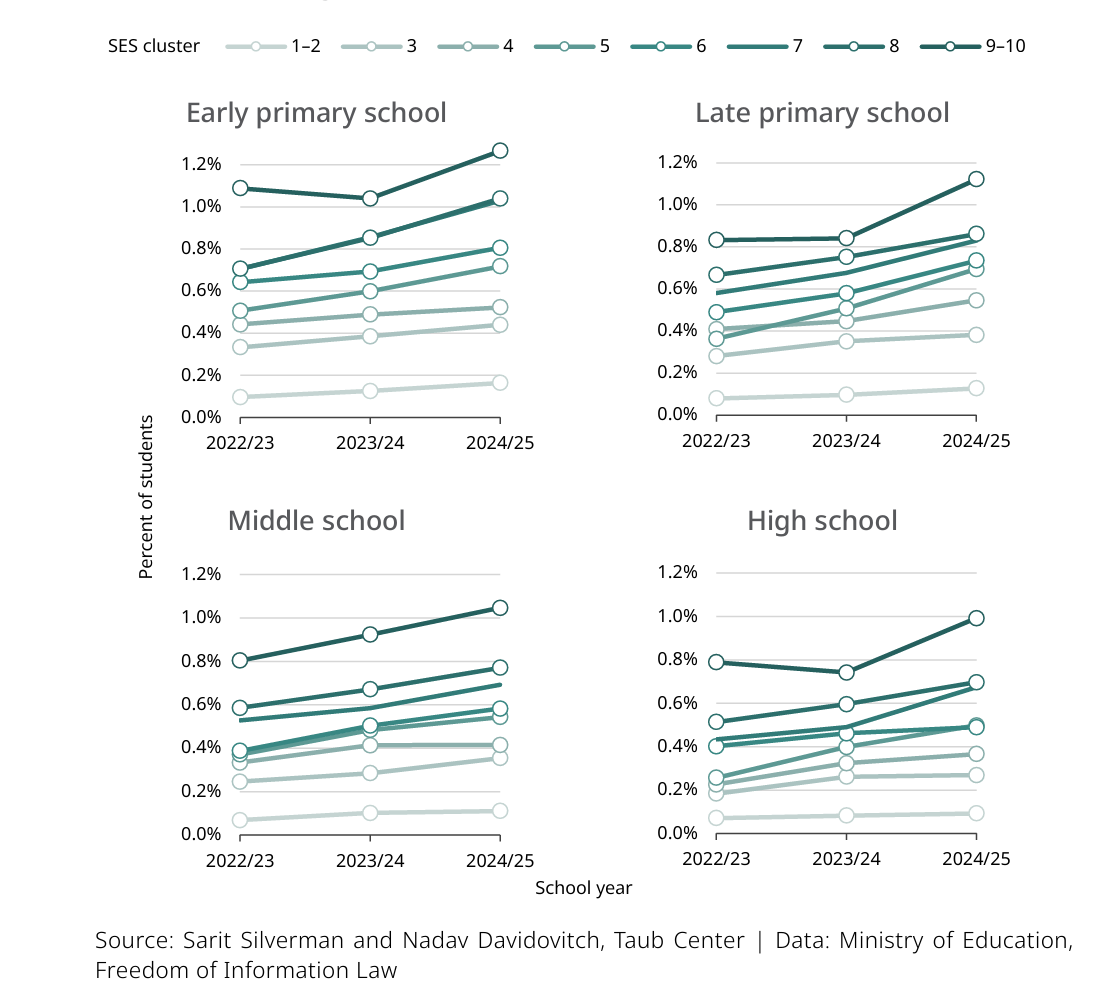
The EpiPen carriage rate was highest in grades 1–2 (0.64% in 2024/25), the only school grades eligible for a medical assistant, even though sensitivity rates in these grades were no higher than in later grades. This pattern suggests that the medical assistant entitlement gives families an incentive to formally document their child’s need for an EpiPen. In the lowest socioeconomic clusters, EpiPen carriage rates barely differed across educational stages, raising concern that this incentive does not operate equally in all communities.
Universal entitlement, unequal access
Eligibility for a medical assistant requires a letter from an allergy specialist. But with a shortage of specialists and limited public allergy services, families who cannot pay for a private diagnosis may be left without diagnosis or care.
In the 2024/25 school year, the sensitivity rate in the highest socioeconomic clusters was 5.06%, compared with 0.65% in the lowest. In grades 1–2, where students are eligible for a medical assistant, the EpiPen carriage rate in the highest clusters was nearly eight times that in the lowest (1.27% vs. 0.16%).
Gaps also emerged across educational streams. In 2024/25, EpiPen carriage rates stood at 0.84% in Hebrew State schools and 0.57% in State-religious schools, compared with less than 0.2% in Haredi, Arab, Bedouin, and Druze schools.
EpiPen carriage rate by socioeconomic cluster and educational stage
Protection ends after grade 2, but risk peaks in adolescence
The medical assistant entitlement ends after grade 2, yet research shows that adolescents are at the highest risk of death from anaphylaxis. Meanwhile, basic safety measures are not consistently available in schools. Ministry of Health inspections found that EpiPen availability was absent or incomplete in 27% of schools inspected.
Rethinking the current policy
In light of these findings, the study presents three policy options for managing food allergies in the education system:
- Restoring school nurses: A nurse in every school would provide professional medical care for all students, while also encouraging vaccination uptake and providing health monitoring and mental health support. According to an estimate by the Knesset Research and Information Center, employing a nurse in every primary and middle school would cost approximately NIS 462–488 million a year, compared with the NIS 523 million allocated to medical assistants for students with food allergies in 2024/25. Implementing this option would require training and recruiting additional nurses, particularly in the periphery.
- Age-differentiated policy: Policy should be tailored to the developmental stage of students, allowing them to gradually develop self-management skills as they grow older. In preschools, where young children are not yet able to manage their allergies independently and placing a nurse in every preschool is impractical, a subsidized mid-morning snack that does not contain the declared allergen, provided to all children in preschool attended by a child with a food allergy, could offer an appropriate alternative to a dedicated medical aide.
- Equal access to basic safety measures: Every school should have a valid EpiPen on hand. In addition, given the disproportionate placement of medical assistants in more advantaged localities, every educational institution must be prepared to handle emergencies, so that students’ protection does not depend on a family’s ability to obtain a diagnosis and claim an individual entitlement.
More research on this topic

A Picture of the Nation 2026: Israel’s Society and Economy in Figures
The Taub Center is publishing this year’s A Picture...
Avi Weiss
“Boundary Crossing Teachers”: A Possible Solution to Staffing Gaps in the Education System
This study by the Taub Center for Social Policy...
David Maagan Nachum Blass
On Real and Perceived Crises in the Education System
State of the Nation Report 2025 – Chapter: Education...
Nachum Blass
The Paradox of Israel’s Healthcare System: Between National Achievements and Ongoing Erosion
State of the Nation Report 2025 – Chapter: Health...
Nadav Davidovitch Natan Lev Ofir Gonen