
Author

Taub Center Staff
On July 20 the Taub Center Initiative on Early Childhood Development and Inequality held a conference entitled Dilemmas and Developments in Early Childhood Care in Israel. The conference was supported by the Beracha Foundation, the Bernard Van Leer Foundation, and Yad HaNadiv, who make the work of the Initiative possible through their generous grants. Participants in the conference were from academia, representatives of social organizations and the Third sector, local authority representatives, senior government ministry staff, as well as those holding a variety of positions in the education and welfare fields.
The conference dealt with a variety of issues related to early childhood and social inequality. Among the topics were: poverty in early childhood and its impact on brain development in very young children and their future educational achievements; manpower shortages in the field of early childhood education and care, which is a central challenge to ensuring quality education for the next generation as well as the opportunity to close social gaps; and, a look into the activities of local authorities that provide hope for advancing the field of early childhood education and care.
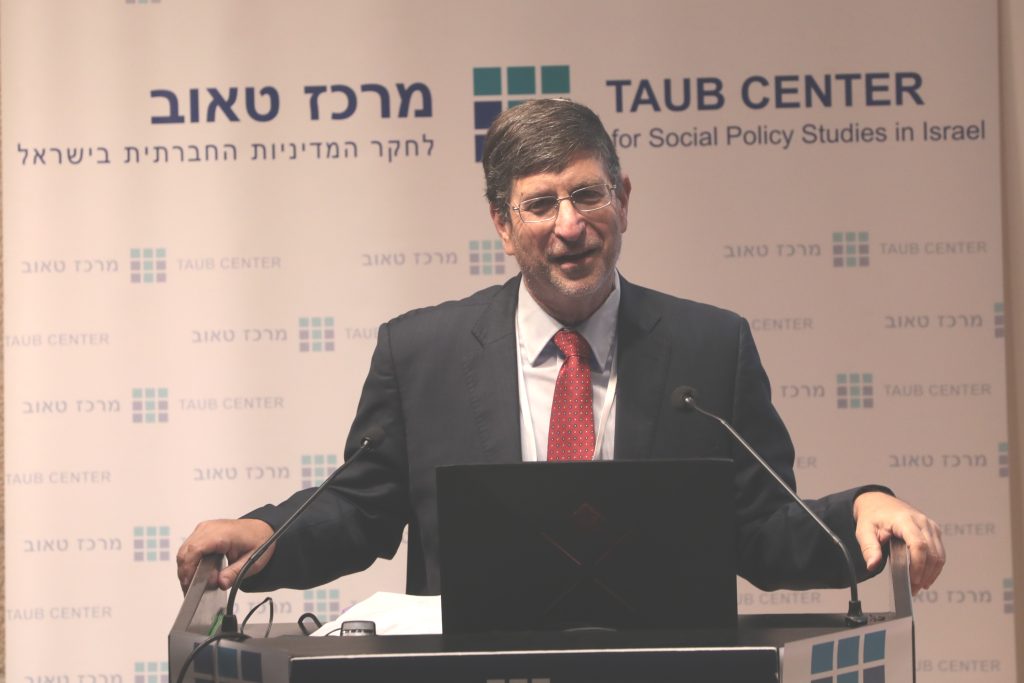 The conference opened with a welcome from Ms. Suzie Patt Benvenisti, Taub Center Director General, Prof. Avi Weiss, Taub Center President, and Prof. Yossi Shavit, Principal Researcher and Head of the Taub Center Initiative on Early Childhood Development and Inequality. Prof. Weiss and Prof. Shavit briefly described the central activities of the Initiative and stressed its importance. A great number of studies show that inequalities are created at very young ages, and that environmental factors can impact the future of very young children. Thus, it is very important to try to understand these factors and to act to reduce inequalities.
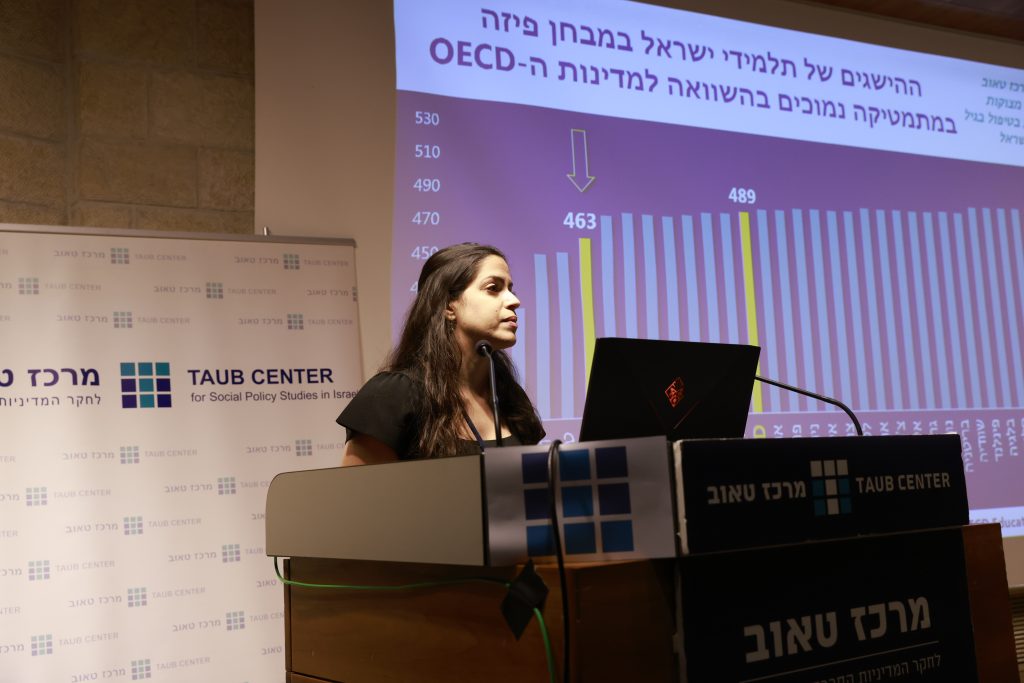 In the first session, Early Childhood, Poverty and Social Benefits, and the Formation of Inequality in Achievements, Dana Shay, a Taub Center researcher, presented the results of two studies that examined the relationship between poverty and success on the Meitzav exams. Her findings show that children from large families that were living in poverty in the “first 1,000 days” – birth to age 3 – score much lower on the Meitzav exams in Grade 5. Following her presentation, Prof. John Gal, Principal Researcher and Welfare Policy Program Chair, further emphasized these findings and presented policy alternatives for dealing with poverty and its influence on very young children. Prof. Gal also suggested creative solutions, like differential child allowances according to the age of the child.

In the second session, Human Resources in Early Childhood Education and Care, led by Prof. Yossi Shavit, the participants were Prof. Meir Yaish, Haifa University, Ms. Sima Shahino, Director of Pedagogy in the Early Childhood Division of the Jerusalem Municipality, Ms. Ola Fakheraldeen, CEO of Yanboa and Director of the Puzzle Initiative, and Ms. Noa Tzur Brosh, Senior Project Manager for Early Childhood Education in the Ministry of Education. Prof. Yaish claimed that, in Israel, there are not a lot of individuals leaving their jobs; rather, people seem to have moved from one position to another. Ms. Shahino presented data showing that in Jerusalem there is a notable shortage of manpower in the field of early childhood education and care, particularly in the general and Haredi sector, and in many cases, it leads to classes being closed. She claimed that in the Arab sector there is no shortage, which can be partly explained by the relatively high status of the position. Fekheraldeen reinforced this with regard to the Arab population, and added that, despite the difficulties and challenges of education and care for very young children, Arab women remain in the profession not only because of the high social status but also because they see it as a calling. The final speaker in the session, Ms. Noa Tzur Brosh from the Ministry of Education, clarified the problem from the government’s perspective, which recognizes the shortage in manpower in early childhood education and care, and presented various Ministry programs to deal with the phenomenon.

The third session, Voices from the Field: Programs to Advance Early Childhood Education and Care at the Local Level, was opened by Dr. Tali Yariv-Mashal, General Director of the Beracha Foundation. She emphasized that local authorities are key players in the field, since they hold the knowledge and data regarding early childhood. Maha Nujeidat, Director of Halakat Project, Yeadim Latzafon, followed her. This project, which focuses on the unsupervised frameworks and operates today in three Arab local authorities in the North, enables the creation of strategic plans in the field of early childhood education and care that consider the particular characteristics of each and every locale. Helen Jacobsohn, the Director of the Early Childhood Center, Pesher-Association for the Development of Welfare and Education Services in the city of Lod, described the activities of the Shahar Initiative (first years of life), a municipal developmental unit that is a joint undertaking of the Ministry of Health, JDC-Ashalim, and the Lod local authority. One of its goals is to ensure that every child who is referred for developmental care receives it. Yehudit Hadad, Assistant to the Mayor of Bet Shemesh on issues of infrastructure and engineering, presented the Urban 95 city initiative. The program, which is a joint effort of the Van Leer Foundation and the Israeli Green Building Council (ILGBC), has a basic premise that the urban environment is not always suited to very young children, and one should think like a toddler who is 95 cm tall in order to create suitable surroundings. Project directors turned to mothers to try to understand what they see as their children’s needs in their neighborhoods. The session was closed by Ms. Tal Ohana, the Mayor of Yeruham, who spoke of the challenges facing her city in the field of early childhood education and care and the solutions they have found. In the discussion that followed between session presenters, there was a general consensus that local authorities hold the greatest potential for the most influence in this field, but in order to do this and to contribute to the advancement of local level activities, there is a need for government resources.
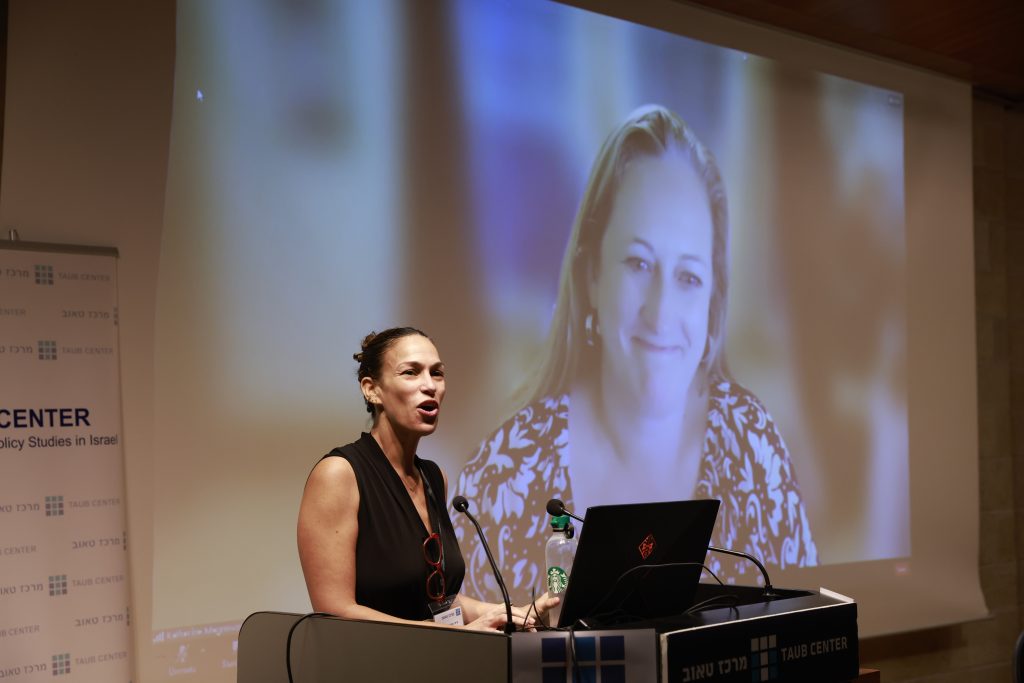
In the final session, chaired by Ms. Liora Bowers, Taub Center Chief Financial and Operating Officer and a researcher in the Taub Center Initiative on Early Childhood Development and Inequality, Prof. Katherine Magnuson of the University of Wisconsin, Madison, the principal researcher in the BFY Project (Baby’s First Years), delivered the keynote lecture (in English) on Unconditional Cash Transfers and Family Processes: Findings from the Baby’s First Years Study. Prof. Magnuson presented the research project which began in the US in 2018, and was designed to examine the relationship between poverty and brain activity related to child development. The interim findings show that among children in families living in poverty who received relatively generous financial assistance through the research program ($4,000 annually), there is increased brain activity related to attention and alertness, while among children whose families received only symbolic support ($240 annually), brain activity related to attention and alertness was less. The final speaker was Prof. Tzipi Horowitz-Kraus, Head of the Educational Neuroimaging Group in the Faculty of Biomedical Engineering at the Technion. Her research, which focuses on the relationship between the environment and brain development of children, has found, among other things, that the right amount of stimulus can improve children’s language development.
The full conference proceedings can be seen by clicking here.
To read the conference participants’ biographies, click here.
More research on this topic

The Preschool Special Education Expansion Problem: Numbers, Trends, and Disparities
The Taub Center releases groundbreaking new research on the...
Sarit Silverman Nachum Blass
Beyond Capacity: The Relationship Between Preschool Class Size and Special Education Participation
This policy paper by the Taub Center shows that...
Sarit Silverman Nachum Blass
The Crisis in Tipat Halav: An Essential Service in Danger of Collapse
The full policy paper is currently available only in...
Nadav Davidovitch Sarit Silverman Efrat Sales Yair Sadaka