
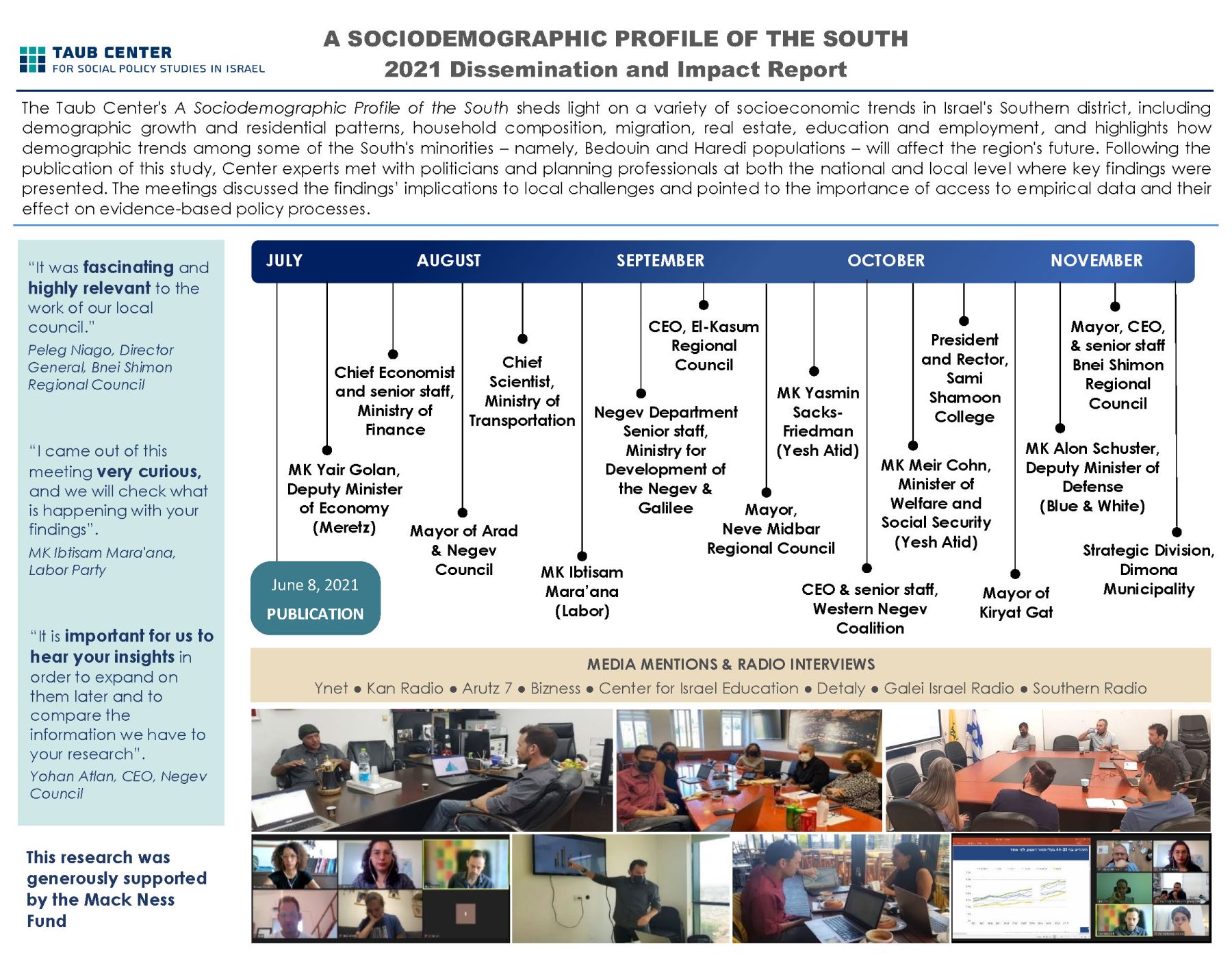
Until now, the Taub Center’s research has examined issues on a national level. However, based on the recognition that the State of Israel is composed of a variety of sub-populations, both on the cultural and geographical levels, the Taub Center has decided to conduct a series of studies with a focus on districts or regions with special characteristics. The study, “A Sociodemographic Profile of the South,” is the first in this series. Following its publication, a series of meetings with a variety of political and professional figures, in both national and local authority governments, including local coalitions, academic institutions, MKs, ministers, mayors and heads of regional councils were held.
The conversations focused on two main populations: the Bedouin and the urban population, which is largely Jewish.
The discussions of the Bedouin population in the Negev centered on its demographic trends, the situation of the younger generation, gender gaps in education, social and structural barriers, etc. In conversations with community leaders, we delved into the reasons and background for the trends that emerged from the research findings. Furthermore, we related to the lack of accurate data on the community, which has created gaps between the research data and the information existing in the field and demonstrated the need for additional research. The issue of the Bedouin population came up in almost every meeting and there was a great deal of interest shown among leaders of both the Arab and Jewish communities, as well as a desire to understand the issue more thoroughly.
In conversations that focused on trends among the urban population (which is primarily Jewish), we presented trends in education, immigration to the South, employment, housing, etc. In many of the meetings, local leaders confirmed that the research matches what they see in their towns and they spoke of their role in advancing positive processes. Many noted that the research provided reinforcement and validity to their work and deepened their understanding of the issues on which they focus in the process of future policy planning.
Nevertheless, there were some findings that surprised most of the participants:
- The issue of first generation in higher education that is related to the characteristics of those moving to the South;
- A continued increase in the number of real estate deals during the Covid-19 crisis, in contrast to other areas of the country;
- The large wave of young people in the Arab population in general and in the South in particular.
Following are selected reactions by senior officials who participated in the meetings:
- “…It was fascinating and highly relevant to the work of our local council.” Peleg Niago, Director General, Bnei Shimon Regional Council
- “I came out of this meeting very curious and we will check what is happening with your findings.” MK IbtisamMara’ana, the Labor Party
- “We were very happy about the research. It is important for us to hear your insights in order to expand on them later and to compare the information we have to your research.” Yohan Atlan, CEO, Negev Council
- “If you decide to go even further, by shining a spotlight on the “dark” regions which do not appear here, that would be a great help to us.” Shai Sofer, Chief Scientist, Ministry of Transport and Road Safety
In all of the meetings, the participants expressed appreciation that the research focused on the region and it was felt that local government officials were thirsty for reliable research findings on specific localities. The participants recounted that they see the manifestations of the research findings in the field and pointed to the link between the unique characteristics of the region — such as in housing, employment, and education — and the findings on issues of satisfaction, immigration, etc.
Despite the size of the Southern Region, during the meetings it seemed like a “small” place from the perspective of the proximity between communities and between people which all seem connected in a tight network. The participants were also very interested in their neighbors, as part of a vision of the region as a shared space in which cooperation between the communities is the key to the success of the region as a whole. During meetings, participants were interested in who else we had met with and wished to hear about the issues raised in other meetings. In our meetings with government officials, we presented, among other things, the issues that were raised in our meetings with officials on the local level and essentially passed that information on.
Long-term effect
During the meetings, we received many requests for future collaboration and additional research in this area. In many of the meetings, participants raised relevant research questions and sought ways to focus specifically on various towns and settlements. They were also interested in segmentations that have not yet been done, such as higher education in the universities and colleges, as well as migration to the cities, towns, and settlements. In all of the meetings, participants were interested in future meetings and many of them mentioned that the information presented would be relevant in their work going forward.
- John Gal, Chair, Taub Center Social Welfare Policy Program and Chair of the Advisory Academic Committee to the Minister of Welfare and Social Affairs, recounted that, in the first meeting of the committee, Minister Meir Cohen mentioned Prof. Alex Weinreb and the findings of the research he carried out on the younger generation among the Bedouin in the South. The research on the Southern Region can serve as an important tool for decision makers and policy makers at a time when the government is investing effort in resolving the issues relevant to the Bedouin population.
- Minister of Welfare and Social Affairs MK Meir Cohen; Nir Zamir, Head of the Bnei Shimon Regional Council; members of the Strategic Department in the Dimona Municipality; and other senior officials expressed interest in future research on the Southern Region and a desire to obtain the research done by Prof. Alex Weinreb on Arab society in Israel, which was published shortly after the series of meetings in the south.
- As a follow-up to the meeting with the Strategy Department in the Dimona municipality, the staff decided to conduct their own research, focusing on their city. In preparation for the research a consultation meeting was held with Prof. Alex Weinreb, in which the members of the Strategy Department expressed how exposure to the research on the South had impacted their work in the municipality and influenced their decision to conduct their own independent research.
Our Impact

Herbert M. Singer Annual Conference: Autism in Israel: Time for Policy Change?
For the conference page, click here
Author
Meeting with the Early Childhood Division, Ministry of Education
Following the Taub Center’s outreach to government ministries upon the publication of the State of the Nation Report, a two-hour meeting was held with the Early Childhood Division at the Ministry of Education. Participants included Dr. Sarit Silverman,…
Author
Prof. Avi Weiss presented the State of the Nation Report 2025 to the staff of the U.S. Embassy in Israel
Prof. Avi Weiss, President of the Taub Center, met with the staff of the U.S. Embassy in Israel and presented the Herbert M. Singer State of the Nation Report 2025. The report provides an overview of the key…
Author
Herbert M. Singer International Conference: Navigating the Future: The Expected Impact of AI on Social Services
For the conference page, click here
Author