
In 2022 service users paid approximately NIS 678 million in copayments –
about 6% of the Ministry of Welfare and Social Affairs’ budget
The full study is currently available only in Hebrew.
Access to assistance through Israel’s welfare system is sometimes conditional on service users contributing toward the cost of services, even when they are living in poverty or facing hardship. Copayments are required for a range of community-based and out-of-home services, including after-school programs for children, day-care centers, residential care, foster care, and services for older adults. The requirement is based on budgetary considerations and on the view that contributing to the cost strengthens service users’ commitment to the treatment process and discourages unnecessary use of services.
A new study by John Gal, Shavit Ben-Porat, and Yael Ovadia is the first in Israel to examine the scope and characteristics of copayments for welfare services. It reviews the arguments for requiring service users to contribute toward the cost of these services and considers the potential implications for access to assistance and for the functioning of the welfare system. The researchers raise concern that copayment requirements may prevent essential services from reaching those who need them most.
In 2022, local authority social services departments served approximately 1.13 million people and about 179,000 of them were required to contribute toward the cost of the services they received. This meant that approximately 15% of all people served by the welfare system that year contributed financially for their welfare services. Total copayments were estimated at NIS 678 million, equivalent to about 6% of the Ministry of Welfare and Social Affairs’ budget.
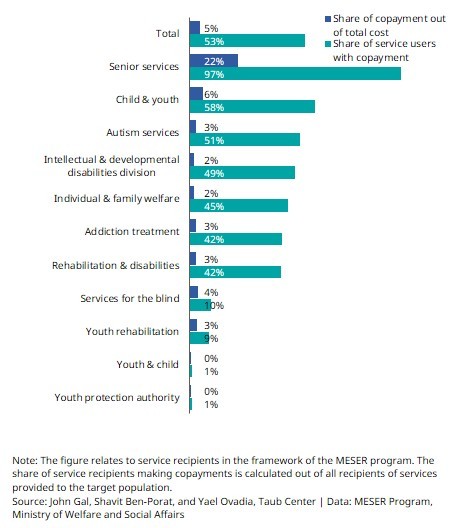
Data for 2022 from the Ministry of Welfare and Social Affairs’ Welfare Services Frameworks System (MESER) show substantial differences in copayment patterns across population groups. According to the data on those receiving services in welfare frameworks, 53% of them paid a copayment. Among people affected by addiction, bereaved families, and older adults, almost all service users paid a copayment. On average, these payments covered between 5% and 22% of service costs. By contrast, almost no copayments were collected from youth in conflict with the law or survivors of sexual assault.
Share of service users in welfare frameworks who paid a copayment, and copayments as a share of service costs, by target population, 2022
Copayments are also used in other countries, but arrangements vary
The study compares seven welfare service areas across Israel, Finland, the United Kingdom, Denmark, the United States, Australia, Canada, and Germany. In all eight countries, copayments are collected for assisted living for older adults, but arrangements differ for other services. In Denmark, for example, low-income families are exempt from paying for after-school programs, and parents are not required to contribute toward the cost of foster care. In Australia and Canada, there is generally no requirement to pay for foster care. In the UK, the requirement depends, among other things, on whether the placement was court-ordered; in the United States, the burden of payments has been reduced in recent years. Copayments for foster care are customary in Israel, Finland, and Germany. In some countries, decisions about payment arrangements are made by regional governments or local authorities, so arrangements may vary from one area to another.
There is no empirical basis for the claim that copayments improve treatment outcomes
The research literature does not provide an empirical basis for the claim that requiring service users to contribute toward the cost of welfare services improves treatment outcomes. A 2024 internal Ministry of Welfare report on service-user copayments reported numerous instances in which people in at-risk groups did not receive services because they could not afford even the minimum required copayment. These cases point to the potential cost of making assistance conditional on payment. However, the scale of the problem has not been measured, and no quantitative data are available to the extent to which people forgo assistance because they cannot afford the required copayment.
A bureaucratic maze of 986 payment rates
The study’s findings point to considerable complexity in the system of copayments for welfare services. In 2022, payments were collected according to 986 different rates, most of which were organized into 35 tables. Some tables included as many as 40 different payment levels. An analysis of the payment levels found that 174 of the 241 levels examined were used rarely or not at all, raising questions about the efficiency of a system with so many levels.
Deepening geographic inequality among service recipients
Service users may request a discount or full exemption from copayments through an exceptions committee, but the process may take months and requires the local social worker to prepare an application and attach supporting documents, adding to their workload. This mechanism assists only about 1% of service users, so some local authorities operate their own arrangements, such as waiving copayments for certain services or handling requests through municipal discount committees, even though no procedure governs this practice. Collection rates also vary among local authorities. Data from two authorities in 2021–2022 show that 10%–11% of payments were not honored in an authority in the Central District with a socioeconomic ranking of 4, compared with 3%–4% in a larger authority in the Southern District with a ranking of 5. These data cover only two authorities and are not representative, but they illustrate the concern that smaller and less-resourced local authorities may find it harder to absorb lost revenue. Differences in local collection and discount arrangements may deepen inequality among service users based on where they live.
Policy alternatives: reducing direct payments and simplifying discount and exemption mechanisms
To reduce bureaucratic complexity, ease the burden on social workers, and reduce inequality among local authorities, the researchers developed several policy alternatives:
- Gradually reduce the scope of services requiring direct copayments, while retaining primarily cost-sharing through deductions from benefits; assess the implications for service users and the welfare budget.
- Establish a permanent team to assess the benefits of collecting copayments against the potential harm to family income and families’ ability to exercise their rights, and to develop criteria for determining when payment should be required and how much should be charged.
- Consolidate the payment tables, reduce the number of payment levels, simplify income tests, and rely on existing administrative data.
- Transfer responsibility for processing applications for discounts and exemptions to local authorities, under the supervision of the Ministry’s district offices, and grant automatic exemptions in clear-cut cases.
- Improve data collection and oversight by consolidating all data on copayments in a single computerized system.
Prof. John Gal, Chair of the Taub Center’s Welfare Policy Program: “A person who turns to the social services department should not have to prove their seriousness and commitment through their wallet. There is no research evidence that payment improves treatment outcomes, and there is evidence that people do not receive assistance because they cannot afford even the minimum amount required. We need to ask what this collection costs families, not only how much revenue it generates. When a system designed to help places a financial barrier in the way of people living in poverty, it risks defeating its own purpose.”
The Taub Center for Social Policy Studies in Israel is an independent, non-partisan socioeconomic research institute. The Center provides decision makers and the public with research and findings on some of the most critical issues facing Israel in the areas of education, health, welfare, labor markets and economic policy in order to impact the decision-making process in Israel and to advance the well-being of all Israelis.
For details, or to arrange an interview, please contact Hadar Horen, Spokesperson: 050-6207943.