
A new Taub Center study shows that, contrary to gloomy predictions that artificial intelligence will render reading, mathematics, and reasoning skills obsolete, demand for workers with strong foundational skills is only expected to grow. Researchers Michael Debowy, Prof. Gil S. Epstein, and Prof. Avi Weiss examined these three foundational skills against the very real concern that technology will reduce demand for human workers.
Foundational skills are worth their weight in gold across all sectors of the economy, and the expansion of artificial intelligence may increase their economic value in the labor market
The study, based on the OECD Survey of Adult Skills (PIAAC) for 2022–2023, shows that workers in occupations exposed to replacement by artificial intelligence, such as software developers, accountants, designers, financial advisers, legal professionals, and clerical workers, tend to have higher levels of foundational skills and are paid accordingly. At the same time, the study shows that the economic return to these skills is nearly identical for workers in occupations exposed to AI and for those that are not, meaning that employers are expected to continue paying more for workers who know how to think, whether or not they use AI tools.
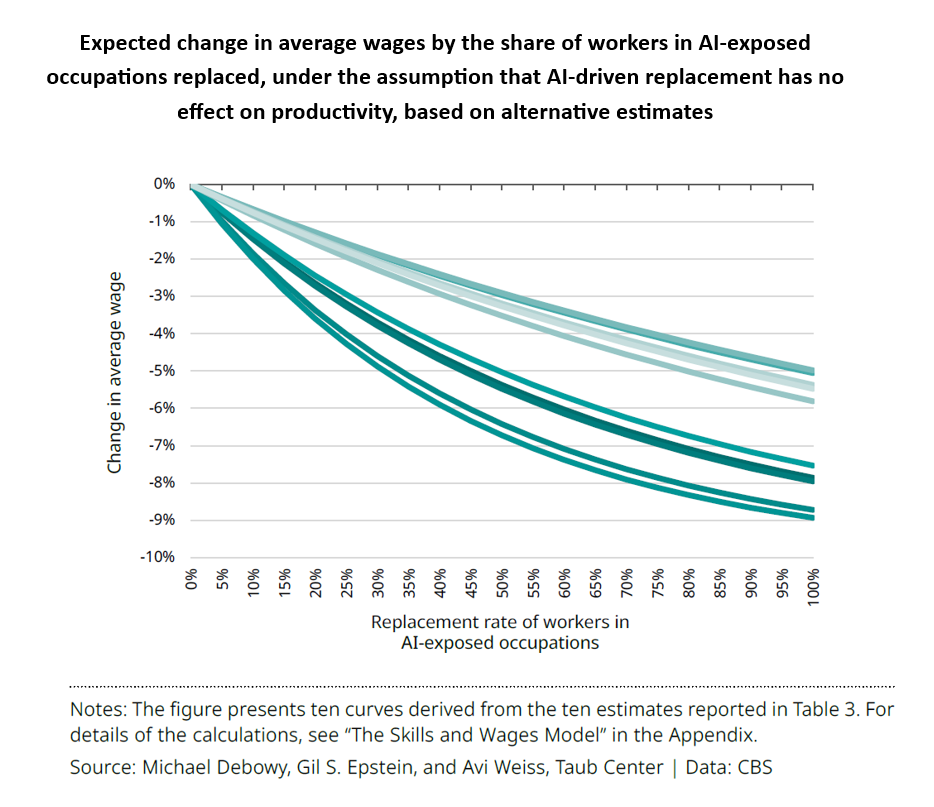
The researchers examined how the integration of AI tools will affect the labor market and found that even in the most highly exposed occupations, the expected impact on wages will be very limited. In an extreme scenario in which most or all workers are replaced, alongside negligible productivity growth, wages are expected to decline by a relatively modest 5%–9%, while in more realistic scenarios (in which about one-quarter of workers or fewer are replaced), the decline would amount to only a few percentage points.
In the more plausible scenario, the adoption of artificial intelligence is expected to reduce labor costs by as much as several tens of percent and generate productivity gains of 3.5%–9%. This increase is expected to offset any wage decline resulting from worker replacement, create new jobs, and raise both demand and wages for workers with high levels of skills.
A warning sign for the Israeli economy: A large gap in foundational skills
Alongside the encouraging message about the importance of human capabilities, the study highlights the international gap in foundational skills. Skill levels among adults in Israel are significantly lower—Israel ranks between 25th and 27th out of the 31 high-income countries examined. This gap is particularly pronounced in the Arab and Haredi sectors, but even among the non-Haredi population, skill levels do not exceed the average for high-income countries, despite Israel being one of the most highly educated countries in the world in terms of formal academic degrees.
Investing in foundational skills will help preserve Israel’s human capital and ensure economic prosperity in the age of artificial intelligence
The researchers call on policy makers, particularly the Ministry of Education and the Ministry of Labor, to invest more intensively in developing and improving workers’ foundational skills. Alongside the integration of AI tools into the education system and vocational training programs, investment is needed to strengthen reading literacy, mathematical reasoning, and the ability to solve complex problems. It is also important to prevent the erosion of skills and to ensure that the everyday use of technology in education and at work does not weaken workers’ ability to think and perform independently. The researchers emphasize that investment in human capital is key to economic growth and to reducing disparities in the new technological era.
Michael Debowy, one of the study’s authors, says: “The data indicate that even in the age of artificial intelligence, the labor market will continue to reward foundational skills in reading, mathematics, and problem solving—perhaps even more than it does today. Workers who want to improve their earning potential should invest in these skills, and the state should make it easier for them to do so. This recommendation is all the more important given the low level of these skills in Israel’s workforce relative to other countries.”
Prof. Gil S. Epstein adds: “Artificial intelligence can read, calculate, and solve problems for us—but anyone who has not acquired these skills themselves will not know how to use AI effectively or recognize when it makes mistakes. Foundational skills are a prerequisite for using technology, not a substitute for it, and precisely because machines can perform these tasks so easily, we must not give them up.”
Prof. Avi Weiss concludes: “The concern about the loss of basic skills in the age of social media and screens is real and troubling. Many young people seem to feel that the development of artificial intelligence makes it unnecessary to invest in foundational skills, but in reality, the opposite is true. The ability to work with and alongside artificial intelligence will require the next generation to have even more advanced skills than those needed today. Recognizing this reality is important not only for government bodies, which are responsible, among other things, for educating our children, but for every parent as well.”
The Taub Center for Social Policy Studies in Israel is an independent, non-partisan socioeconomic research institute. The Center provides decision makers and the public with research and findings on some of the most critical issues facing Israel in the areas of education, health, welfare, labor markets and economic policy in order to impact the decision-making process in Israel and to advance the well-being of all Israelis.
For further details or to arrange an interview, please contact Chen Mashiach, the Center Spokesperson: 054-7602151