
This study is currently available only in Hebrew.
For most of Jewish history, conversion was seen as having limited demographic impact. Since antiquity, and for more than 1,500 years, the contribution of conversion to the growth of the Jewish population was almost negligible. However, changes that have taken place in recent decades in liberal Western societies, including the rise in Jews’ social status, the expansion of populations with an affinity to Judaism, and changes in perceptions of identity, have made conversion a more realistic option for many people. As a result, it now has a greater potential to affect demography.
A new Taub Center study by Prof. Alex Weinreb, Research Director and Head of the Demography Program, examines the scale of conversion in Israel and its demographic contribution through an analysis based on conversion rates by age and sex. The study aims to produce conversion estimates that are more valid from the perspective of demography as a scientific discipline. It focuses on Israel only and does not include a comparative analysis or quantitative measurement of conversion processes in Jewish communities outside Israel. Its findings point to a gap between the picture that emerges from raw annual data and the cumulative impact of conversion.
The scale of conversion in Israel is affected, among other things, by the provisions of the Law of Return, which grants residence and citizenship rights in Israel to children or grandchildren of Jews and to their spouses and children, even if they are not Jewish according to halacha. In Israel’s official statistics, produced by the Central Bureau of Statistics (CBS), this group is defined as “Others” or as having “no religious classification.” The study focuses on the Others population, which numbered about 475,000 Israelis in mid-2025, and whose growth rate in the five years preceding October 2023 was the highest among Israel’s population groups. This population is considered the main pool of potential converts.
Raw data reflect an incomplete picture
In 2020–2023, 11,420 conversions were carried out in Israel. In 2022, for example, the share of converts was about 0.7% of the Others population, and their direct contribution to the Jewish population, which numbered about 7.17 million people, was less than 0.05%. These figures reflect a relatively low annual scale. However, the raw data are not an appropriate measure for assessing the demographic impact of conversion.
Age has a significant effect on the decision to convert
The study examines the probability of conversion by age, based on the “life table” method. According to 2022 conversion data, girls who were born in Israel or arrived at a very young age have a 7.6% probability of converting by age 5 and a 13.1% probability by age 15. The probability of conversion rises substantially in the late teenage years and in the 20s. By age 25, the cumulative probability is 37.5%; by age 35, it is 45.9%; and by age 45, it is 49.3%. At older ages, the age-specific probability of conversion is considerably lower, and therefore the increase in the cumulative probability is very moderate.
The cumulative lifetime probability of conversion for women and men born in Israel or arriving in Israel by age one,
given age-specific conversion rates, 2020, 2021, and 2022
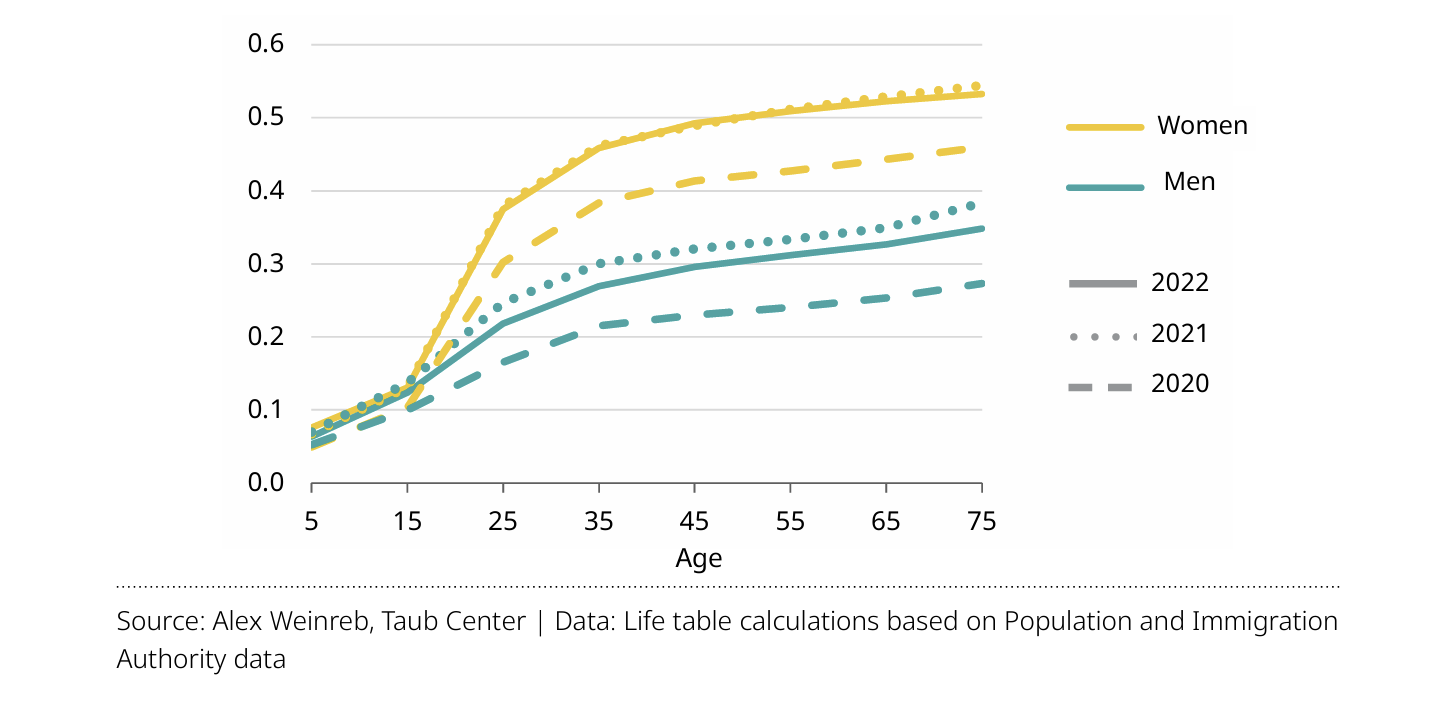
The age structure of the Others population affects the overall picture. A large share of this population is between ages 40 and 60, when conversion rates are, at most, 5% of the rate among people in their 20s. This is the main source of the incomplete picture reflected in the raw data.
The share of young women who choose to convert is higher than that of men at the same ages
The study also points to consistent differences between women and men. Conversion rates among women are higher across most age ranges. Thus, of about 121,000 women in the Others population ages 0–39 in 2022, 30,878, or about 25%, are expected to convert by age 40, assuming age-specific conversion rates remain at their current level. Among men, by contrast, the cumulative probability of conversion is lower at almost every age, and the gap becomes especially notable after the teenage years. Of about 127,000 men in the Others population ages 0–39 in 2022, 16,160, or 12.7%, are expected to convert by age 40.
The conversion of young women may affect future generations
The study also examined the indirect demographic contribution of conversion through fertility, using a simulation based on standard fertility rates. The estimates indicate a significant demographic impact: for every 10,000 female converts, between 17,400 and 26,100 children who will be defined as Jewish will be added over their lifetimes. This effect applies to the first generation only, but it may accumulate across generations.
Prof. Alex Weinreb, Head of the Taub Center Demography Program and Research Director at the Center: “The importance of religious identity in Israeli demography makes conversion rates a significant demographic component in population analysis. While in general demography the main components of change are births, deaths, and migration, in Israel, changes in the size of the Jewish population can also be affected by conversion. The study’s findings show that conversion may have a significant demographic impact, and that these processes occur gradually over time. As the study shows, a superficial look at a simple data table presents a misleading snapshot that suggests failure, when in fact there is considerable success. A clear assessment of conversion rates will make it possible to create a more accurate foundation for policy planning.”
The Taub Center for Social Policy Studies in Israel is an independent, non-partisan socioeconomic research institute. The Center provides decision makers and the public with research and findings on some of the most critical issues facing Israel in the areas of education, health, welfare, labor markets and economic policy in order to impact the decision-making process in Israel and to advance the well-being of all Israelis.
For further details or to arrange an interview, please contact Hadar Horen, the Center Spokesperson: 050-6207943.