
A new Taub Center study examines changes in housing patterns among a fixed population over time in 2013–2022, based on the longitudinal survey of the CBS (Central Bureau of Statistics). In their study, Prof. Benjamin Bental and Dr. Labib Shami focus on three main housing tenure categories: homeownership, renting, and living in a family-owned home. The study points to a slow increase in the share of households living in a home they own and, accordingly, a parallel decline in the share of households living in rental housing or in homes owned by relatives. These trends characterize the population as a whole, but there are substantial differences between population groups, mainly by income and household size.
An increase in homeownership rates in Israel, particularly in Arab society
As expected, given that the study follows a fixed population that was surveyed several times over the years, the researchers found that among the sampled households, the share living in a home they own rose gradually but consistently, from about 62% in 2013 to 69% in 2022. This trend was accompanied by a similar decline in the share of renters and in the share of those living in homes owned by relatives. These trends are consistent with the natural increase in household size and rising household income.
A particularly significant change was recorded in Arab society. Within a decade, the homeownership rate among the Arab sector households surveyed in the sample jumped by 19 percentage points, from 60% in 2013, slightly below the rate among Jewish households, to 79% in 2022, 10 percentage points higher than among Jewish households. At the same time, the share living in family-owned homes fell sharply over this period, from 18% to only 7%. This process may reflect a cultural and economic shift in Arab society, from a traditional housing model of living in a relative’s home to living in a home owned by the household.
Housing tenure patterns among Israelis are consistent over time
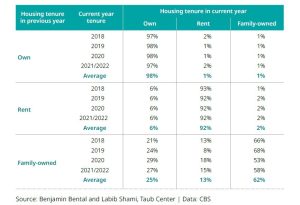
Alongside the change in homeownership that occurs over time, the survey data point to considerable consistency in housing tenure choices. On an annual average, about 98% of homeowners and about 92% of renters remain in the same housing status in the following year. About 62% of households that reported living in a family-owned home continued this living arrangement in the subsequent survey year. Even when households move and change their address, the connection to the familiar housing path remains strong. This can be seen in the fact that 71% of homeowners who moved moved to another property they own, and about 69% of renters who moved moved to another rental home. By contrast, only 9% of households that had lived in a family-owned home and changed their address moved to another home that was also owned by a relative. About 51% of these households that changed their address moved into rental housing.
Likelihood of a transition between housing tenure types, 2018‒2021/2022
An increase in the share of low- and middle-income households in the rental market
One of the study’s notable findings concerns the relationship between households’ demographic characteristics and the housing tenure they choose. The data show that household size is significantly related to housing tenure. Over the decade examined, the share of one-person households in the survey population remained constant, at 21%. The share of these households among homeowners also remained constant, and is lower than their share in the survey population – 15%. Among renters, by contrast, one-person households are considerably overrepresented in the survey population, and their share even increased over the decade, from 32% to 38%. In contrast to these households, the shares of other household compositions among homeowners reflect their shares in the population.
Another central factor is the age of the head of household. In 2013, young households aged 20–30 were substantially underrepresented among homeowners, but as the households aged, this underrepresentation among homeowners declined considerably. By contrast, the overrepresentation of households in the 31–50 age groups among renters, and even more so among those living in a family-owned home, remained unchanged. This finding points to the tendency of those living in family-owned homes to remain in this housing tenure.
In general, income level has no substantial effect on homeownership rates. However, among the Jewish population, there is a certain positive association between income and the homeownership rate, which strengthened slightly over the survey years. By contrast, among the Arab population, no such association was found, and homeownership rates are similar across all income levels.
In the rental market, there was an increase in the share of households from the low- and middle-income deciles in both population groups in 2021–2022 compared with 2014, most likely due to rising home prices. In 2014, living in a family-owned home was characteristic mainly of the lower income deciles, particularly among the Arab population. Over the years, however, among Arabs the association between income and living in a family-owned home disappeared, while among Jews, the share of low-income households in this living arrangement actually increased.
Israelis own their homes for about 15 years on average
The average length of residence in a single home is about 14.5 years, and the median is about 14.6 years. These figures are underestimates, since the survey records the date of home purchase, but the date of departure is known only for households that reported a change of address between one survey wave and the next.
International comparison: Israel is more similar to the Anglo-Saxon countries and less similar to Western and Eastern European countries
In international comparison, Israel is similar to other high-income countries. In the United States, the average length of residence in an owned home in 2022 was 12.3 years, below the peak of 13.4 years recorded in 2020. Particularly expensive cities, such as Los Angeles and San Francisco, are characterized by longer residence durations, exceeding 16 years on average. In England, by contrast, the average length of residence of homeowners in their properties was about 10 years in 2019–2022 and about 9 years in 2015–2018, apparently against the backdrop of pressures in the mortgage market.
The study shows that homeownership rates in Israel are not unusual by international standards. According to cross-sectional surveys, in 2023 Israel’s homeownership rate, about 71%, was very similar to the OECD average and close to the figures reported in Anglo-Saxon countries such as the United States, about 66%, Canada, about 70%, and the United Kingdom, about 68%. By contrast, Israel differs from various countries in Western and Central Europe, where rental housing is much more dominant due to rent controls. For example, in Germany, about 55% of the population lives in rental housing and the homeownership rate is only about 41%; in Austria, the rental rate is about 47%, compared with a homeownership rate of about 45%. As the study shows, the model of living in homes owned by relatives is a unique feature of Israel, although, as noted, among the survey population, residence in this model is on a downward trend.
Prof. Benjamin Bental, Principal Researcher and Chair of the Taub Center Economic Policy Program: “The study’s findings show that the structure of Israel’s housing market, in terms of the balance between homeownership and renting, is similar to the OECD average. However, in countries where the rental market is tightly regulated, rental rates are much higher. In Israel, it appears that despite high housing prices, many households still prefer to make the effort to purchase a home, apparently because homeownership provides a sense of security and economic and personal stability. In light of all this, it is important to invest in designing policy that focuses both on lowering housing prices and on establishing a stable long-term rental market.”
Dr. Labib Shami, Taub Center Senior Researcher: “The study reveals two significant trends relating to Israel’s housing market. On the one hand, households tend to maintain their housing tenure over time. On the other hand, the change in Arab society stands out: an accelerated process of home purchases alongside a sharp decline in living in family-owned homes. This is a substantive change, since it enables these households to leverage their ownership of the asset for investments in physical and human capital.”
The Taub Center for Social Policy Studies in Israel is an independent, non-partisan socioeconomic research institute. The Center provides decision makers and the public with research and findings on some of the most critical issues facing Israel in the areas of education, health, welfare, labor markets and economic policy in order to impact the decision-making process in Israel and to advance the well-being of all Israelis.
For further details or to arrange an interview, please contact Hadar Horen, the Center Spokesperson: 050-6207943.