


This study by the Taub Center for Social Policy Studies in Israel examines how artificial intelligence (AI) is reshaping the composition of the unemployed in Israel. The researchers — Michael Debowy, Prof. Gil S. Epstein, and Prof. Avi Weiss — found that while AI’s impact on overall unemployment remains limited, it is already altering who becomes unemployed. AI explains part of the shift in the occupational distribution of the unemployed between 2022 and 2025, particularly since the second half of 2024.
The erosion of job security among skilled workers
The study shows that AI’s impact is concentrated in occupations that previously enjoyed very strong demand, low layoff rates, and persistent vacancies. These occupations, which had especially low unemployment rates in 2022, are now experiencing the most pronounced increases in relative unemployment.
The findings indicate a significant rise in the share of unemployed individuals coming from occupations at high risk of displacement by AI. While between 2019 and 2022 these workers accounted for about 14%–16% of all unemployed in Israel, by 2025 their share had risen to 20%–25%. The vacancy rate in these occupations has also declined accordingly.
This trend is not driven by AI alone. It also reflects structural factors such as the slowdown in the high-tech sector, the growing share of digital-age occupations at risk of automation (among both the employed and the unemployed), and the partial regression from structural changes brought about by the COVID-19 crisis. The study suggests that, relative to these other factors, AI accounts for a modest share of the overall change.
Share of unemployed individuals in occupations at high risk of displacement out of total unemployed, and share of job vacancies in occupations at high risk of displacement out of total vacancies, annual average by quarter, 2019‒2025
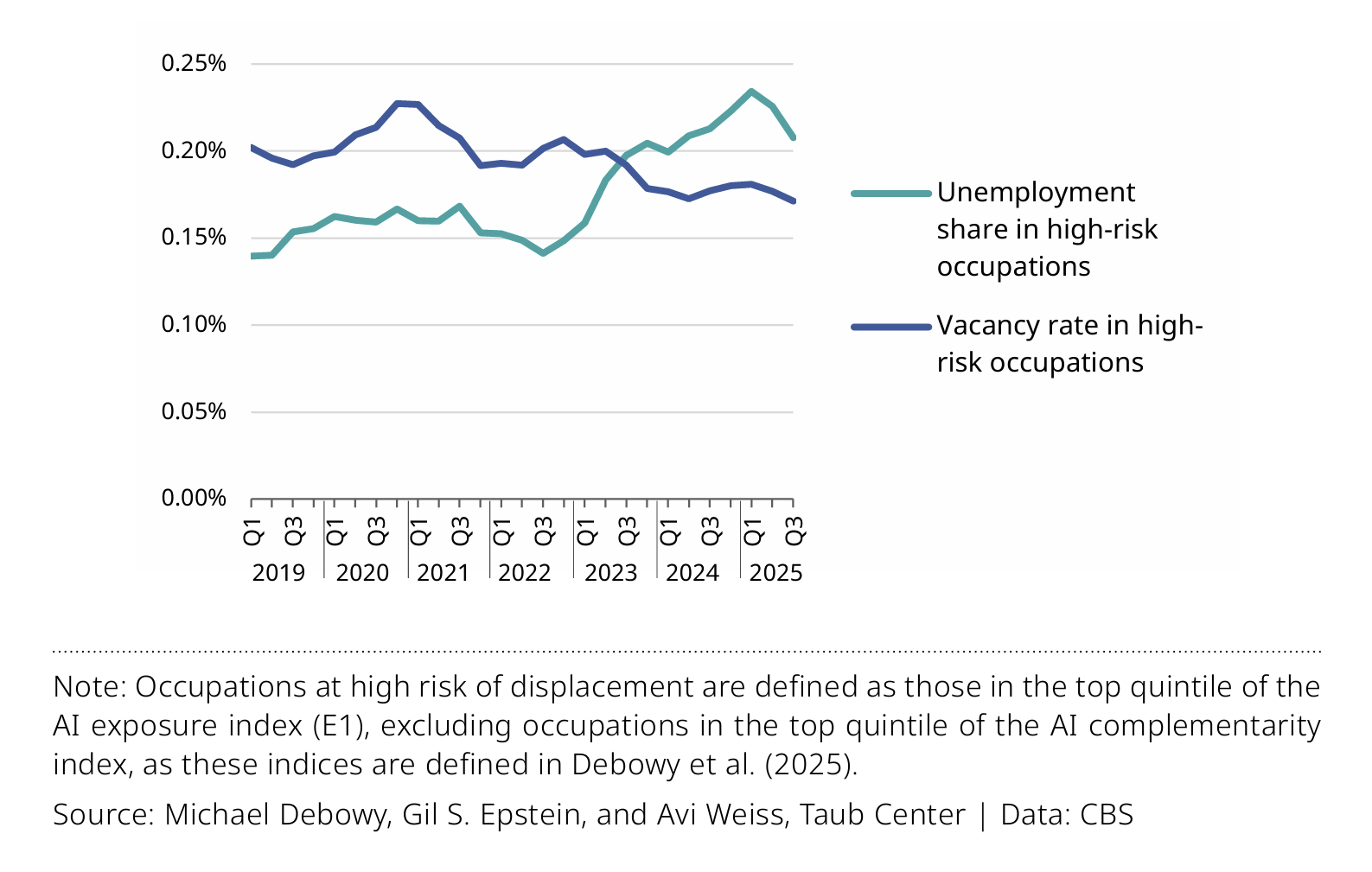
Two occupations stand out in this context: software developers and telephone sales representatives. Among software developers, AI explains between 12% and 20% of the increase in unemployment recorded between 2022 and 2024–2025; among sales representatives, it explains between 10% and 26% of the increase. In both cases, the effect reflects not only a decline in the number of vacancies but also a shift in skill requirements, which has made it harder to match unemployed workers to available jobs.
Are younger, less experienced workers the most affected?
The researchers note that rising unemployment in AI-exposed occupations is driven not only by disappearing jobs but also by a growing mismatch between workers and available positions. In occupations where vacancies have not declined at the same pace as unemployment has risen, unemployed workers appear to face increasing difficulty in integrating into existing jobs due to changing employer requirements.
This pattern is consistent with a growing preference for more experienced workers. In practice, AI enables experienced and highly skilled workers to become significantly more productive, potentially shifting demand away from those at the beginning of their careers. This finding aligns with evidence from the United States, which documented a 13% decline in employment among young workers (ages 22–25) in occupations at risk of automation, while more experienced workers were largely unaffected.
In Israel, this trend is particularly pronounced among programmers. The research suggests that a substantial share of AI’s impact on unemployment in this occupation reflects a shift in demand from entry-level workers toward more experienced programmers. In fact, in occupations such as software development and telephone sales, at least half of AI’s impact on unemployment is attributed to a decline in workers’ ability to meet the new requirements of available positions.
Overall unemployment remains stable, but the nature of the labor market is changing
The researchers emphasize that although the impact of artificial intelligence on Israel’s overall unemployment rate remains insubstantial, the changes it is driving cannot be ignored. Unemployment has not risen in the AI era, but the composition of the unemployed has shifted. AI already explains between 2% and 6% of the change in the occupational distribution of the unemployed. The data show that even in occupations where the number of vacancies has remained relatively stable, competition for each position has intensified, as the number of skilled unemployed workers competing for them has increased. This places growing pressure on job seekers, who are now required to demonstrate higher levels of experience and skill than in the past to secure a position.