


This policy paper is only available in Hebrew.
The Appeals Committee system for social services in the Ministry of Welfare and Social Security is intended to ensure the right of social service recipients to appeal decisions made in their cases by local authorities. Despite the importance of this procedure, This Taub Center policy paper by Prof. John Gal, Yael Ovadia, and Shavit Ben-Porat shows that, over the years, the number of appeals submitted to the committees has been very small and that most appeals are rejected.
The appeals system has been in operation for 60 years and is based on district committees whose role is to reexamine decisions made by social services departments on issues such as social care, material assistance, and community services. Today, only four district appeals committees operate in Israel, compared with 16 committees in 2001.
Most appeals are submitted in the area of “individuals and families”
The data presented in the paper show that most of the appeals submitted in 2013–2024 concerned the area of “individuals and families”, that is, they focused on welfare services intended to assist families. In recent years, this area’s relative share has declined, and the gap between it and the second most common area, “children and youth” services for children at risk or children suffering from a variety of social problems, has narrowed. “People with disabilities” is the third most common area.
The data show that, over the years, there has been a significant decline in the ratio between the number of appeals submitted to the Appeals Committees and the number of recipients of services from social services departments. Over the past two decades, between 155 and about 1,000 appeals were submitted each year, while between 1.1 million and 1.3 million people were registered with social services departments in those years. While in 2004–2005 about 8.5 appeals were submitted per 10,000 service recipients, by 2013 the figure had declined to about 3.9 appeals, and in 2020–2021, it stood at only about 1.5–1.7 appeals per 10,000 service recipients. In 2024, the number of appeals submitted was 2.8 per 10,000 service recipients.
At the same time, the number of Appeals Committees was gradually reduced from 16 committees in 2001 to 13 committees in 2013, and today there are only four district committees.
Ratio of the number of appeals submitted to the appeals committees to the number of service recipients in social services departments, per 10,000 service recipients
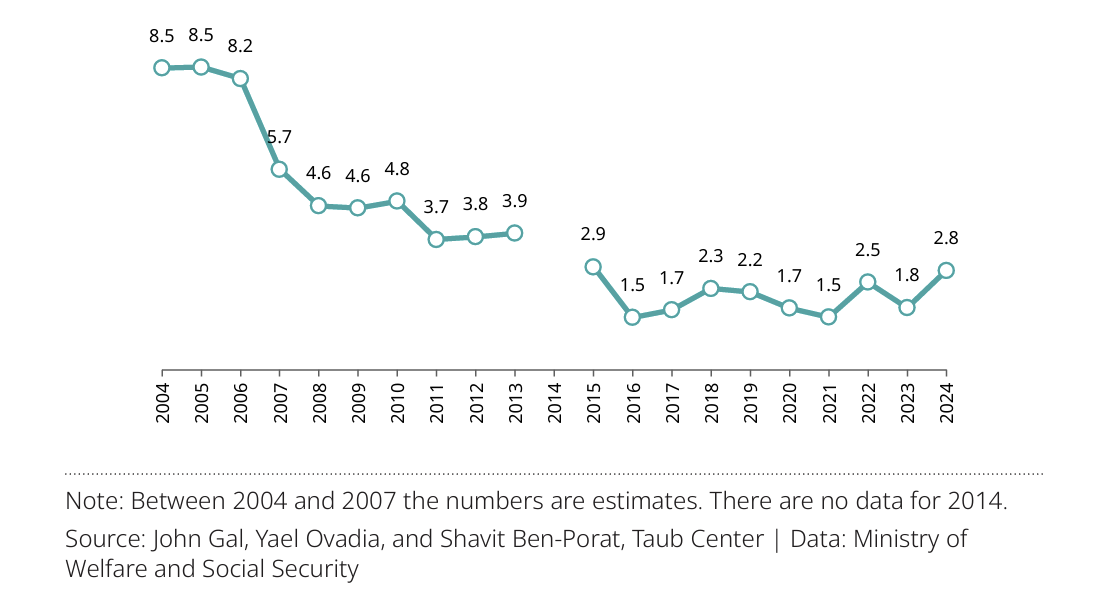
Note: Between 2004 and 2007 the numbers are estimates. There are no data for 2014.
Source: John Gal, Yael Ovadia, and Shavit Ben-Porat, Taub Center | Data: Ministry of Welfare and Social Security
Most appeals submitted to the Appeals Committees are rejected
An examination of the history of the appeals system points to high rejection rates throughout the decades of the Appeals Committees’ activity. In the 1970s, 57% of appeals were rejected; in the early 2000s, 64% were rejected; and in 2023, the rejection rate reached 79%.
An analysis of the decisions made regarding appeals submitted in 2017–2023 shows that rejection rates ranged from 66% in 2018 to 82% in 2021. In 2023, the share of appeals in which the committee changed the welfare department’s decision in favor of the appellant was very low, ranging from only 3% to 6%. Fewer than one-fifth of appeals were referred back to the social services department for reexamination. According to the policy paper, there is no accessible information regarding follow-up on these cases and it is not known what was subsequently decided in their regard.
The Ministry of Welfare’s 2024 Freedom of Information report presented, for the first time, a more detailed breakdown of appeal outcomes. According to the report, 60% of appeals were rejected, 27% were dismissed due to lack of jurisdiction, and 6% were cancelled because the appellants received what they had requested before the committee convened. According to the authors, the new level of detail is a positive step, as over time it will make it possible to identify trends in the area of appeals and improve the process for the benefit of all parties.
Despite the changes made to the appeals system over the years, the number of appeals has remained small and rejection rates high
In 2012, a significant change was made to the Appeals Committee system, intended to increase its independence and strengthen its professionalism. As part of this change, the composition of the committees was altered, and both sides were given the option of appealing the committee’s decisions to the Administrative Affairs Court. In recent years, digital appeal forms have also been added, along with the option of submitting an appeal through the Ministry of Welfare and Social Security website.
However, the policy paper shows that even after the changes made to the system, the number of appeals has remained very small and rejection rates continue to be high.
The paper presents several possible barriers that may explain the low number of appeals. These include barriers related to awareness and knowledge, bureaucratic barriers, and perceptual, psychological, and cultural barriers. Another explanation may lie in the option of contacting the Ministry of Welfare in parallel through the public inquiries mechanism, although the double bureaucracy involved in applying through two separate channels may sometimes discourage service recipients and cause them to give up in advance.
With this, it is likely that when the relationship between the service recipient and the professionals in the department is functioning properly, many complaints that might otherwise develop into appeals are resolved at earlier stages.
More research on this topic

A Picture of the Nation 2026: Israel’s Society and Economy in Figures
The Taub Center is publishing this year’s A Picture...
Avi Weiss
Welfare and the Shadow of Warfare
Welfare Chapter State of the Nation Report 2025: Taub...
John Gal Shavit Ben-Porat Yael Ovadia
Welfare System Performance During the War and Policy Proposals
The full research is available in Hebrew only. With...
John Gal Shavit Ben-Porat Yael Ovadia
Who Provides Welfare and Education Services? Local Spending on Welfare and Education in Israel
Local elections are just around the corner, prompting the...
John Gal Adi Tarabeih