


Over the past few decades, there have been changes in the education and employment of women in Israel: their labor participation rates are growing alongside a continued widening of educational gaps — both high school and academic — to the benefit of women. Despite this, gender wage gaps remain among the highest in the OECD. Taub Center researchers Michael Debowy, Prof. Gil S. Epstein, and Prof. Avi Weiss examined the relevant factors to wage gaps — monthly and hourly, gross and net — between men and women in the various sectors in Israel.
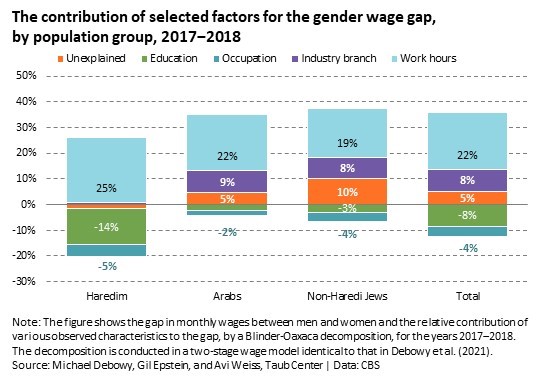
The study found that variables like work hours, parenting, occupation, and industry branch, influence the gender wage gap that in 2018 was about 35% in gross and 28% in net monthly income to the advantage of men. The vast majority of this disparity is due to differences like the number of work hours, however, it is possible that these differences have their origins in gender norms. The unexplained portion of the gender wage gap is about 5%.
The largest gaps were observed among non-Haredi Jews and Others, while the smallest gaps were among Haredi Jews. Interestingly, in the past few years there have been opposing trends in the Arab and Haredi sectors. Among Arabs, wage gaps have been growing while among Haredim, they have been narrowing. Among Haredim, the gender wage gap narrowed from 31% in 2014 to 24% in 2018. Apparently, this change is due to the increasing participation of unskilled Haredi men in the labor market, who tend to work a limited number of hours and for lower wages than Haredi women.
With regards to hourly wages, the Taub Center researchers found that in 2018 the average wage gap was 21% for gross wages and 11% for net wages. As with monthly wages, here, too, the greatest disparities were among non-Haredi Jews and Others. Women in this group earned, on average, about 25% less than men per work hour. In contrast, among Haredim, the gap in hourly wage reversed to the benefit of Haredi women since 2014, and in 2018, the hourly wage of Haredi women was higher than that of Haredi men; their gross hourly wage was 6% higher than that of men and their net hourly wage was about 13% higher. Among Arabs, the gross hourly wage disparity, which was almost non-existent in 2014 (and perhaps actually favored women), grew to about 15% by 2018. It is possible that this growth was the result of more Arab women entering the labor force in low paying jobs.
A comparison of monthly and hourly wage disparities shows that, in the Haredi sector, gender wage gaps are completely explained by differences in work hours, while in the rest of the population, the number of work hours explains only a portion of the gaps.
Wages, work hours, and parenting
Due to gendered norms of parenting, it is likely that a portion of the wage disparity can be explained by pregnancy, childbirth, and child rearing. This research presents hourly and monthly wage gaps between men and women on the basis of the number of children under age 10 in the household. These findings show three things. First, even among people who are not parents, gender wage gaps exist — 39% in monthly wages and 18% in hourly wages — so gendered parenting norms explain only a portion of wage gaps. Second, among parents with one to three children, wage gaps are similar to those with no children. Third, among parents of four children or more, the lion’s share of the wage gap is explained by differences in work hours between men and women. This means that the relation between raising children and gendered wage gaps is relatively loose, and is primarily seen for parents with four or more children.
Occupation and industry
The study also presents a multivariate analysis that examines the relationship between each variable and the monthly wage gap. It was found that the number of work hours explains a sizable portion of the gap, and among non-Haredi Jews and Arabs, the effect of the choice of economic industry branch is also quite substantial. After controlling for these explanatory variables, there is still an unexplained gap of about 5%.
It is interesting to note that there are also variables that work to narrow the gap — occupation and education. The study predicts that if it were not for the advantage that women have in levels of education and their choice of occupation, the gender wage gap would be greater by about 13 percentage points in the overall population, about 7 percentage points among non-Haredi Jews and others, about 4 percentage points among Arabs, and about 19 percentage points among Haredim.
More research on this topic

Are you satisfied with your work? You must have good interpersonal relations
How satisfied are you with your work and how...
Haim Bleikh
Migration Patterns in Mixed Cities in Israel: Socioeconomic Perspectives
Migration is a change in the permanent residence of...
Benjamin Bental Labib Shami
In honor of International Women’s Day the Taub Center has published recent data on gender disparities in the labor market
A new study, published in time for International Women’s...
Taub Center Staff