Author

The Taub Center has published a special paper ahead of the upcoming elections, pointing to a sharp rise in the threshold for entering the Knesset, driven primarily by the growth in the voting-age population since the 2022 elections. Prof. Alex Weinreb, Head of the Demography Program at the Taub Center, warns of the risk of another major loss of votes.
The surge in the number of eligible voters
In the 2022 elections, the threshold for entering the Knesset stood at approximately 155,000 valid votes. In those elections, nearly 420,000 votes were effectively wasted—8.8% of all votes cast—equivalent to about ten Knesset seats. In the upcoming elections, the threshold is likely to be considerably higher because of the growth in the voting-age population: from 6.789 million eligible voters in November 2022 to approximately 7.561 million by the end of October 2026. This increase reflects the entry of relatively large birth cohorts into the voting-age population and substantial waves of naturalization among new Israelis.
How many votes will be needed to enter the Knesset in the 2026 elections?
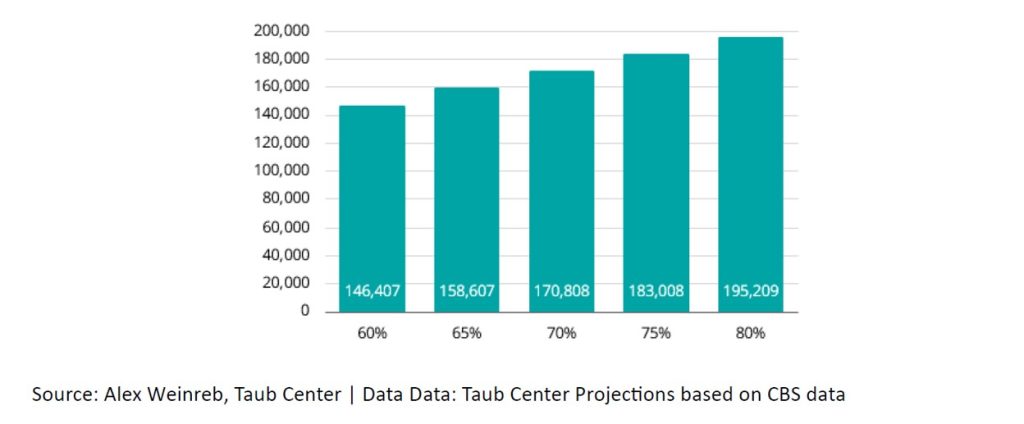
The absolute threshold depends on a combination of the number of eligible voters and voter turnout. The scenario analysis presented in the paper shows that with a moderate turnout rate of 70%, the ticket to the Knesset would require approximately 171,000 valid votes. If turnout rises to 75%—as a result of political tensions and heightened public engagement—the threshold would climb to approximately 183,000 votes. In a scenario in which 80% of citizens exercise their democratic right to vote—slightly above the turnout rates recorded from the 1970s through the 1990s—a party would need to secure approximately 195,000 votes in order to pass the electoral threshold.
A call for responsible political action
Prof. Weinreb emphasizes that the higher the voter turnout, the more votes will be required to pass the electoral threshold. In numerical terms, every one-percentage-point change in voter turnout will alter the threshold for entering the Knesset by approximately 2,240 votes. In practice, he adds, this means that party leaders who cannot ensure the support of at least 200,000 voters are directly endangering their political bloc. Moreover, leaving hundreds of thousands of voters without representation seriously undermines public trust in democracy and state institutions. In light of the data presented in the paper, he calls on the leaders of small parties and their advisers to act responsibly: if estimates suggest that their party is unlikely to cross the 200,000-vote mark, they should reconsider their course of action—either withdraw from the race or join forces with other parties and run on a joint list—so that the loss of votes seen in the previous elections is not repeated.
Anticipated electoral threshold in the October 2026 election, by turnout rate