
Author

Demography chapter, State of the Nation Report 2025:
Since the establishment of the State, Israel’s population growth rate has fallen below 1.5% only twice: to 1.42% in 1981 and to 1.35% in 1983. Israel’s growth rate in 2025 is set to break that record: according to our estimates, it will be about 0.9%.
Prof. Alex Weinreb, Taub Center Research Director and Chair of the Demography policy group, examines the three components of demographic change in Israel: mortality, fertility, and migration, as part of the Demography chapter of the State of the Nation Report 2025. The analysis focuses on developments in fertility and birth rates among different population groups, trends in mortality and their future implications, and patterns of migration to and from Israel.
Life expectancy in Israel is high, but the number of deaths is expected to surge
Life expectancy in Israel in 2023 stood at 83.7 years. Among OECD countries, only Switzerland, Japan, and Spain achieved a higher figure. Life expectancy in Israel was 5.3 years higher than in the United States and 2.7 years higher than in the United Kingdom. A breakdown by population group shows that all groups — except Arab men, whose outcomes are affected by a high rate of homicides — have returned to the upward trend that characterized them prior to COVID-19 pandemic.
Although life expectancy has risen in recent years and is expected to continue rising — albeit not at the pace seen in the second half of the 20th century — the absolute number of deaths is increasing, from about 46,000 in 2018 to about 51,000 in 2024. This trend is driven mainly by Israel’s age structure: large age cohorts of Jews and Arabs have begun entering their 70s and 80s — ages at which mortality rates rise sharply. The annual number of deaths is expected to increase by about 77% by 2040 (an increase of 71% in the Jewish population and 111% in the Arab population).
Stability in the number of births creates the illusion of stagnation, but in fact fertility is declining
Over the past decade, the annual number of births in Israel has remained stable. The data show that this overall stability in the absolute number of births since 2016 has occurred despite significant declines in fertility rates in almost all population groups. Jewish women are the only group whose fertility rates have been relatively stable and are even higher today than in 2005, although they have declined considerably since 2018. The fertility rate of Jewish women is roughly twice that of Druze or Christian women, and about 0.4 children higher than that of Muslim women.
The declines in fertility rates are expected to reduce natural increase (the difference between the number of births and deaths) in each group, especially in the Arab population. Over the coming decade, a substantial slowdown is expected in the growth of the number of Arab women of childbearing age. If fertility rates continue to decline, the absolute number of births in this population will fall.
Based on the fertility patterns of Jewish women in their twenties, completed fertility among secular women and traditional women who are not religious is expected to approach 1.7 children per woman by the end of the 2030s — slightly higher than in Northern Europe and North America today. Among religious women, including traditional-religious women, fertility is expected to decline to about 2.3 children per woman, and among Haredi women it is expected to decline to 4.3 children per woman. Parallel trends are also expected in Arab society, where fertility is projected to decline to 2.7 among religious women and to 2.0 among non-religious women.
A historic slowdown in population growth: The end of an era of rapid natural increase
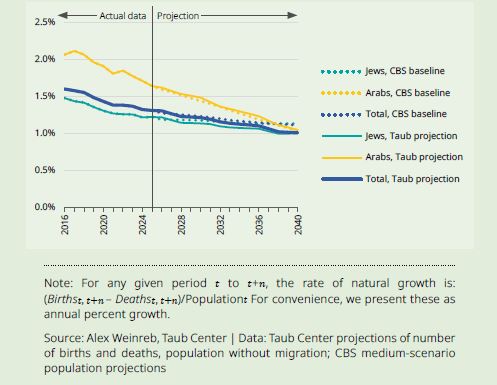
Between 2016 and 2025, Israel’s annual natural increase rate fell from 1.6% to 1.3%. A particularly sharp decline was observed in the Arab population, where the rate fell from 2.1% to 1.6%. The main reason is a stable number of births alongside a 43% increase in the number of deaths, following rapid growth in the number of older adults in Arab society.
Among Jews and “Others” (those who are not classified in the Population Registry as Jewish, Muslim, or Arab Christian), the natural increase rate declined from 1.5% to 1.2%. These rates are expected to continue to fall, such that by 2040 Israel’s overall natural increase will stand at about 1%.
This represents a substantial change in the source of Israel’s demographic growth. In the two decades prior to the COVID-19 pandemic, at least 80% of Israel’s annual demographic growth stemmed from natural increase, with the remainder due to net migration, but in recent years this relationship has changed. Given the ongoing decline in fertility and the expected rise in the number of deaths, migration will play a more significant role in demographic change — whether growth or decline.
In the foreseeable future, the number of births will continue to exceed the number of deaths. However, Israel is no longer expected to experience annual growth rates of 1.9%–2.0% as a matter of course. Moreover, the country will need positive net migration to maintain demographic growth above 1.3% in 2025, above 1.2% through 2030, and above 1% through 2040. Even so, these figures still reflect high demographic growth compared with other high-income countries.
Israel’s recent and projected rate of natural growth (%), by subpopulation, 2024‒2040
Negative net migration: A sharp shift in Israel’s migration patterns in 2024
In 2024, for only the fourth time in this century, net migration — the number of immigrants entering Israel minus the number leaving — turned negative. The number of people who left Israel exceeded the number who entered (including new immigrants) by 26,000. In 2025, this trend is expected to continue, with the gap projected to reach 37,000. Given the CBS method for calculating migration, a negative net migration balance is also expected in 2026. This plunge into negative figures marks a major change in Israel’s migration patterns, with no precedent in the country’s history.
The current wave of emigration mainly reflects remigration of Israelis who were not born in Israel, about one-third of whom are immigrants who are not Jewish according to halakha (“Others”). This group of immigrants grew disproportionately in 2015–2019. Emigration rates among this group are 8.1 times those of Jewish Israelis (both Israel-born and foreign-born).
Although emigration among Israel-born Israelis is lower, a steady upward trend has still been evident over the past three years
It is important to note that despite the surge in the number of people leaving in recent years, emigration rates from Israel remain low in international comparison. In 2024, the crude emigration rate from Israel was 83 per 10,000 residents — an unusually high value for Israel, but only slightly above the European Union median. In 2025, Israel’s crude emigration rate is expected to stand at 78 per 10,000 residents, falling below the median.
The 2025 data also point to declines in the number of Israelis returning to Israel and in immigration to Israel. Based on data from the first nine months of the year, the number of immigrants to Israel in 2025 is expected to be the lowest since 2013 (excluding 2020, the COVID year).
Israel’s true net migration
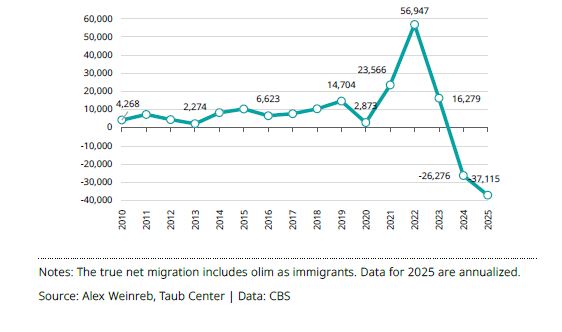
A persistently negative net migration rate is expected to reduce Israel’s population growth. The overall picture — declining natural increase alongside negative net migration (a negative balance between those leaving and those entering) — points to a net loss of about 37,000 people in 2025. As a result, Israel’s total population growth rate in 2025 fell to 0.9%, less than half the average annual growth rate in the decade preceding the COVID period. This marks a significant shift in Israel’s demographic landscape.
The destinations of Israel-born Israelis who emigrate are diverse. Fewer and fewer Israelis are moving to traditional destinations such as the US, Australia, and the UK, and more and more are choosing Germany, Cyprus, and countries in East Asia as their migration destinations. This suggests changes in Israelis’ motivations for emigration, foremost a search for lifestyle change rather than purely economic considerations. The diversification of destinations also points to a changing role for Israel within global Jewish communities, potentially signaling its emergence as a kind of metropolis that sustains and helps maintain small Jewish communities outside Israel.