


Following the events of October 7, the Israeli economy faces a new security reality, accompanied by a significant increase in defense spending. According to estimates, over the next decade, the defense budget is expected to average about NIS 120 billion a year. In order to finance these expenditures while maintaining the standard of living of Israeli citizens, the need to generate new engines of growth has become more urgent.
This Taub Center study examines investment in public capital and the possibility of turning it into a central engine of growth. The researchers, Prof. Benjamin Bental and Michael Debowy, show that increasing investment in public capital is one of the most effective tools for achieving growth and ensuring the country’s economic resilience. The researchers point to Israel’s ongoing retreat from investment in public capital, its considerable potential for growth, and the ways in which investment in public capital is expected to affect various industries in the economy.
Public capital and infrastructure as a basis for growth
Economic studies and international data from recent decades point to a close and significant link between investment in public capital and growth in GDP and labor productivity. Public capital, which includes physical infrastructure such as transportation and energy and “soft” infrastructure such as health and human capital, is a necessary condition for proper and efficient economic activity. Studies conducted in OECD countries and other high-income economies show that increasing the stock of public capital is an investment that yields a high economic return, improves access to markets, lowers production costs, and improves citizens’ quality of life.
Israel’s persistent lag: The public capital stock is about half the average in other high-income countries
The study found that compared to other high-income countries with similar populations and higher GDP than Israel (Austria, Denmark, Finland, the Netherlands, and Sweden — the reference countries), Israel’s public capital stock relative to GDP is considerably lower, consistently amounting to only about half the average ratio in these countries.
To close this gap, Israel would have had to invest more in public capital than these countries over the past few decades, but this did not happen. On the contrary, there has been a continuous decline in investment rates: while in the 1990s Israel invested about 80% of the level of investment in the reference countries, in the second decade of the current century (2010–2019) there was a significant retreat, and this figure fell to only about 62%. The researchers emphasize that this situation contributes to the decline in labor productivity and limits the economy’s growth potential.
From micro to macro: The effect of public capital on the business sector
To examine the impact of infrastructure shortages on actual economic activity, the researchers analyzed a large database based on the industry and business surveys of Israel’s Central Bureau of Statistics (CBS). The analysis, which covers about 25,000 companies and plants in Israel, shows that increasing the stock of all types of public capital examined has a large, positive, and significant effect on business sector output. However, the nature of this effect varies by type of infrastructure and economic industry. For example, transportation infrastructure is a key growth engine for high-tech industries and other knowledge-intensive services, while development of the electricity grid directly affects productivity in traditional industries and in high-tech and financial services. Alongside these, investment in “soft” infrastructure, such as health and human capital, was found to make a significant and unique contribution to improving output in the service industries. These findings underscore that an effective investment policy must take into account the unique needs of each industry.
Increasing investment in public capital could raise Israel’s GDP by at least NIS 6 billion per year
The study reveals the impressive economic feasibility of investment in infrastructure in Israel. According to the findings, under the most conservative assumptions regarding the effect of productivity growth among individual producers on the economy as a whole, an annual addition of NIS 4 billion to the public capital stock (NIS 1 billion for each of the four types of infrastructure examined: the electricity grid, transportation, health capital, and human capital) is expected to increase GDP by about 0.4% a year, translating into about NIS 6 billion a year. In other words, under the most conservative scenario, investment in these areas could yield a return of 50% each year and hundreds of percent over time.
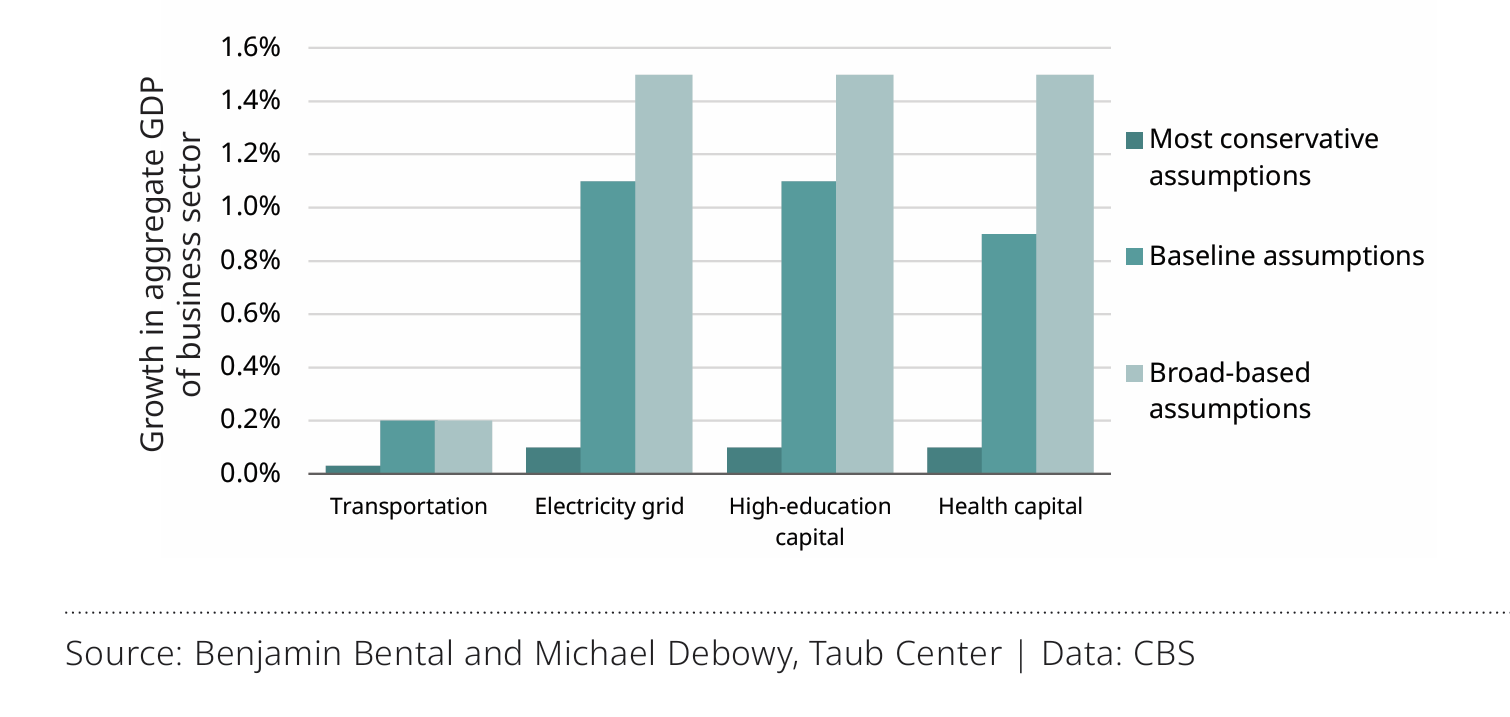
Under a less conservative scenario, in which the return on investment is examined according to the baseline assumptions (the most reasonable assumptions), investment of NIS 1 billion in transportation infrastructure is expected to increase GDP by about 0.2% each year, translating into an addition of about NIS 2.8 billion a year. An identical investment in health capital assets, the electricity grid, and human capital assets would each yield a larger increase of about 0.9%–1.1%, or about NIS 13–14 billion a year.
In each of the scenarios, whether based on conservative assumptions or on the baseline assumptions, the study’s findings show that investment in each of the types of infrastructure examined is highly worthwhile. In light of this, the researchers call on the government to act to substantially increase investment in public capital, including advancing projects such as the metro, upgrading the electricity grid, and investing in the education and health systems. Increased investment, they emphasize again, is one of the most effective tools for strengthening the growth of Israel’s economy over time.
Estimates of growth in aggregate GDP of the private sector as a result of an investment in infrastructure of NIS 1 billion
More research on this topic

The Consumer Price Index, Housing Costs, Consumer Credit, and the Cost of Living
This study by the Taub Center addresses the perception...
Benjamin Bental Labib Shami
A Picture of the Nation 2026: Israel’s Society and Economy in Figures
The Taub Center is publishing this year’s A Picture...
Avi Weiss
Is the Israeli Economy Recovering?
State of the Nation Report 2025 – Chapter: Macroeconomic...
Benjamin Bental Labib Shami
The fiscal consequences of changing demographic composition: Aging and differential growth across Israel’s three major subpopulations
Among high-income countries, Israel has an unusual demographic profile....
Kyrill Shraberman Alex Weinreb